Showing posts with label picture book. Show all posts

Friday, March 6, 2020

Dr. Naomi Hamer's "Enter Through The Gift Shop: Transmedia Storytelling and the Picture Book from Mobile Apps to Museums.”


On Wednesday February 19th, SDSU hosted Dr. Naomi Hamer for her talk, “Enter Through the Gift Shop: Transmedia Storytelling and the Picture Book from Mobile Apps to Museums.”

Dr. Naomi Hamer with Dr. Angel Matos

Dr. Naomi Hamer is an Associate Professor in the Department of English at Ryerson University and the co-author of “More Words About Pictures: Current Research on Picture Books and Visual/Verbal Texts for Young People”, as well as the co-editor for Genesis Journal. She is a children’s literature and settler scholar and studies cultural theory, identity, and audience studies, among many other exciting topics! Although she is highly knowledgeable in a wide range of topics, this specific talk focused on her book that is currently under review, Enter Through the Gift Shop: Cross-media Play with the Picture Book from Mobile App to Museum. She described the content as the “greatest hits” of her research. 

Loading screen of the Pisim App Developed by 
Dr. Hamer & Her Fellow Colleagues

As Dr. Hamer explains, picture books rarely are designed just as a singular book. Many are quickly followed by merchandise, movies, and sometimes sequels. This is where her studies of children’s literature and other forms of children’s media converge. 

Although apps on various electronic devices are often seen as in opposition to a physical book, Dr. Hamer argues against condemning technology based on the sentimentality and tradition of reading a solitary, physical book. She instead advocates for reading and analyzing apps and corresponding literature in conjunction. These apps are a new remediated form, often interacting with the real world in virtual or augmented reality, and many provide an intersection of oral storytelling and materiality. An example of this is a story app with a projector, but there are many other ways of transmedia storytelling for children that can be found just on a phone. 

There is a cultural value of picture book art, as seen in museums which feature children’s books and their authors, such as the Mo Willems traveling exhibit and The Eric Carle Museum of Picture Book Art located in Massachusetts. However, almost all museums are heavily regulated, exemplified with iPads in exhibits locked both physically and virtually, thus limiting a child’s interaction, unlike if they were given a book or something else with a wider range of motion and exploration. Children are given the opportunity to express creativity, but in an isolated area and with limited forms.

Children’s art station at the Eric Carle Museum of Picture Book Art. Personal Photo 2016. 

It can be suggested that these children’s museums exist more as a kind of giant advertisement than a place of learning, as suggested in the title of Dr. Hamer’s book and talk, Enter Through the Gift Shop. Sometimes, the only way of entering or leaving a museum is through, or at least walking past, the gift shop with tie-in merchandise ready for kids (and their parent’s credit card). Dr. Hamer pointed out the irony that the only interaction available to young viewers in the museum is this merchandise. 

The inspiration for the title of the talk

Moseum shop image. New York Historical Society. Personal photo 2016. 

This leads into Dr. Hamer’s work of decolonizing museums and children’s co-curatorship in museums. Framed by the Truth and Reconciliation Commission of Canada's Calls to Action, Dr. Hamer is a research collaborator on the Six Seasons SSHRC-funded Partnership Grant lead by  Dr. Mavis Reimer at the University of Winnipeg. The project aims to extend the creation of picture books and affiliated apps as part of a project of language and cultural reclamation as well as other processes of reconciliation. Here’s where her new app, Pisim, comes in. Pisim is an interactive story with rich illustrations and cultural notes, a fictionalized narrative of the young Cree woman found by archeologists in 1993. Pisim was developed in collaboration with Knowledge Keepers and Elders of the Asiniskaw Ithiniwak (Rocky Cree) communities of northern Manitoba. Available in both Cree and English, Pisim follows the journey of Pisim and her family and encourages reflection of Rocky Cree Culture. 

The menu of the Pisim app.
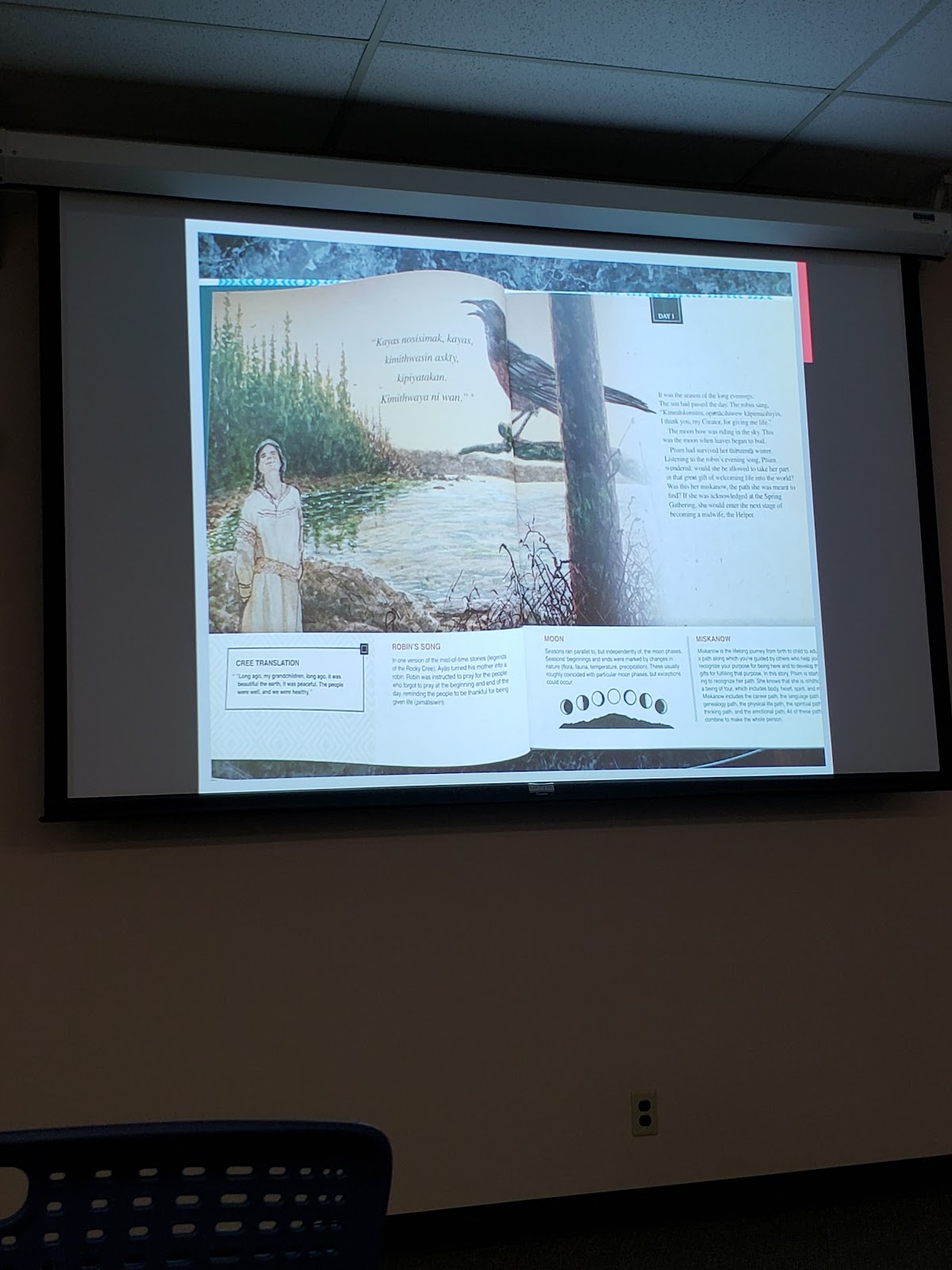
A page from the Pisim book that the app was based upon.

Unlike most museum exhibits, in which viewers can look at but cannot touch the art object, Pisim invites kids to immerse themselves in the object of their observation. Not only are kids given reign in the story, through conversation with the Truth and Reconciliation Commission of Canada, Dr. Hamer’s team involved Indigenous children in the process of creating the app, and children are given co-curatorship in the creation. Children are invited to help test the apps and collaborate on early pilots. Indigenous children and teens are currently testing her second application that is in progress. 

The app’s narrator: a Cree elder.

Through this app, there is remediation as a process of dialogue. Children at times are led to sit and reflect on the content of the game and its real-life meaning. Turning oral stories to applications allows for more access than going to someone from a tribe, or going to a museum. 

Dr. Hamer’s talk highlighted the fascinating trend towards the “New Literacies” that are developing for children. The screen has become a medium that transmediates canonical texts and is also a place for experimentation of new content. It has found its way into museums as an attempt for interaction, but still faces limits as to user accessibility. The transmediation from book to screen remains contested, but Dr. Hamer’s lecture revealed exciting possibilities for the future of what counts as children’s literature.

-(SS) and (AN)

Tuesday, February 18, 2020

Aesthetics of Cicada by Shaun Tan


This semester, San Diego State University is offering an “Aesthetics of Children’s Literature” graduate seminar taught by our very own director, Dr. Joseph Thomas Jr. Of course, I signed up for it as soon as I could, hoping to get answers to the simple question of “what makes certain texts better than others?”  – only to be told that such explanations would not be given. Instead, we discussed Terry Eagleton’s concept that “part of what we mean by a ‘literary’ work is one in which what is said is to be taken in terms of how it is said” (3). Our goal this semester would be to look at how things are said – the technique or methodology that goes into the final product. As we wrapped up our fourth class session, heads heavy with the discussion of six published articles, Dr. Thomas urged, “Go find out what your aesthetic values are!”
Cicada by Shaun Tan


Emboldened by the challenge, I reread a picture book that had shocked me with its content a few weeks prior: Cicada by Shaun Tan. During the first read, it was easy to see the thin varnish of the cicada protagonist, which glossed over a forthright tale of the difficulties of Asian American assimilation into the American workforce. The parallels were clear: the diminutive, hardworking, unacknowledged main character is cast as subhuman, denied resources and a living wage, and endures it all without complaint. All of these observations deal with the book’s content, an aspect much too easy for me to home in on given my concurrent independent study work reading Lisa Lowe and James S. Moy.

Yet in class, Dr. Thomas had lectured on the two outlooks currently dominating literary criticism. The direction that most critics are taking is that in which texts are studied ideologically. When analyzing, they ask, “How does the text’s content reflect the culture in which it was written, and what would modern ideology have to say about it now?” Clearly, this is the methodology I used to examine Cicada on my first read, hastily drawing a conclusion from Tan’s personal ethnic background and eagerly impressing my own interpretation onto the cicada’s journey to molting. I hadn’t considered the other outlook, the one our graduate seminar emphasizes, which is a focus on the aesthetics of texts. Scholars using this lens would ask, “What makes a text pleasurable and beautiful?” Throughout this semester, this complex question will become my own. Therefore, I decided to test it out right away. Equipped with a few articles’ worth of information, I tackled Cicada once again to extract its aesthetic features. 
Pages 1 and 2

Pages 3 and 4


First, the artwork. Aside from a double-page spread at the beginning and three at the end, most of the spreads are split with the text on the left and a full-page image on the right. Most of the color is made up of shades of gray that never quite turn into black. This provides a strong contrast for the main character, the cicada, who is green aside from his gray suit. The cicada himself stands at half the height of humans, stretching to reach the elevator button but just small enough to fit into the office wall space he calls home. While he is always just off-center in each page, humans are always in the periphery: either walking away, turning their backs, or – in the one case a human is looking at the cicada – headless. As he goes to the roof to molt his office body and emerge as a red, winged insect, the cicada casts aside the whole narrative that he had just built. No text is needed here, for the striking visual of the red distinctly marks a rebirth and shedding of the discrimination that his green, suit-clad body had endured. Truly, the story could have been conveyed through the artwork alone. But it is not. Somehow, the narration is necessary.
Pages 22 and 23


The text itself is bland on the surface – even the cicada seems apathetic about his situation as he describes being overworked, beaten by coworkers, and ostensibly walking to the roof to commit suicide. It’s not so much that the message is hard to understand; rather, the delivery itself is short, clipped, and direct. Subject-verb agreement is rare, if both subject and verb even make into the sentence. Tiny and centered, the isolated lines connote a loneliness that elides the question of whom the cicada is telling this story to, despite his informative tone. Each page of text has three lines, followed by the mantra “Tok Tok Tok!” which makes the visual image of a quatrain. Each line has no more than two periods in it, one of which is always at the end of each line. After reading the haiku above the book details in the back, one is led to wonder if the text is made up of haikus with the “Tok Tok Tok!” added at the end, but the syllables do not match up. 
A discreet haiku

Pages 29 and 30


It is not until the very end of the book, in which a double-spread of text on a white background separates the “Tok Tok Tok!” from the three lines that always proceed it, do readers understand that it is a laughing sound. The emotionless, drab tone that had characterized the text is revealed to be the result of the “Tok Tok Tok!” sapping away all emotion into itself. On a second read, the cicada is reenvisioned as unbothered by his horrible work conditions because he himself reflects upon it with a laugh. Those three syllables obliquely contain disdain, jubilance, and an air of superiority. The cicada gets the last word and the last laugh.

Being unfamiliar with poetry and art makes approaching picture books with an aesthetic eye difficult. Yet Cicada’s direct language and underwhelming illustrations easily lent itself to a fruitful analysis. I could see how information-rich the images are, while extracting the necessity of the text for its visual impact and the change of tone that occurs between a first and second read. As I continue searching throughout the semester to figure out what makes a text aesthetically pleasing, I can add “unapparent, buried tone” and “color contrast” to my list as a result of studying Cicada by Shaun Tan.
- (AN)

Works Cited

Eagleton, Terry. How to Read Poetry. Yale University Press, 2013.