On Wednesday February 19th, SDSU
hosted Dr. Naomi Hamer for her talk, “Enter Through the Gift Shop:
Transmedia Storytelling and the Picture Book from Mobile Apps to Museums.”

Dr. Naomi
Hamer with Dr. Angel Matos
Dr. Naomi Hamer is an Associate Professor in the Department of English at Ryerson University
and the co-author of “More Words About Pictures: Current Research on Picture
Books and Visual/Verbal Texts for Young People”, as well as the co-editor for
Genesis Journal. She is a children’s literature and settler scholar and studies
cultural theory, identity, and audience studies, among many other exciting
topics! Although she is highly knowledgeable in a wide range of topics, this
specific talk focused on her book that is currently under review, Enter
Through the Gift Shop: Cross-media Play with the Picture Book from Mobile App
to Museum. She described the content as the “greatest hits” of her
research.

Loading screen of the Pisim App Developed by
Dr. Hamer & Her Fellow Colleagues
As Dr. Hamer
explains, picture books rarely are designed just as a singular book. Many are
quickly followed by merchandise, movies, and sometimes sequels. This is where
her studies of children’s literature and other forms of children’s media
converge.
Although apps on
various electronic devices are often seen as in opposition to a physical book,
Dr. Hamer argues against condemning technology based on the sentimentality and
tradition of reading a solitary, physical book. She instead advocates for
reading and analyzing apps and corresponding literature in conjunction. These
apps are a new remediated form, often interacting with the real world in
virtual or augmented reality, and many provide an intersection of oral
storytelling and materiality. An example of this is a story app with a
projector, but there are many other ways of transmedia storytelling for children
that can be found just on a phone.
There is a cultural
value of picture book art, as seen in museums which feature children’s books
and their authors, such as the Mo Willems traveling exhibit and The Eric Carle
Museum of Picture Book Art located in Massachusetts. However, almost all
museums are heavily regulated, exemplified with iPads in exhibits locked both
physically and virtually, thus limiting a child’s interaction, unlike if they
were given a book or something else with a wider range of motion and
exploration. Children are given the opportunity to express creativity, but in
an isolated area and with limited forms.

Children’s art station at the Eric Carle Museum of Picture Book Art.
Personal Photo 2016.
It can be suggested
that these children’s museums exist more as a kind of giant advertisement than
a place of learning, as suggested in the title of Dr. Hamer’s book and talk, Enter
Through the Gift Shop. Sometimes, the only way of entering or leaving a
museum is through, or at least walking past, the gift shop with tie-in
merchandise ready for kids (and their parent’s credit card). Dr. Hamer pointed
out the irony that the only interaction available to young viewers in the
museum is this merchandise.

The inspiration for the title of the talk

Moseum shop image. New York Historical Society. Personal photo
2016.
This leads into Dr.
Hamer’s work of decolonizing museums and children’s co-curatorship in museums. Framed by the Truth and Reconciliation Commission of Canada's Calls to
Action, Dr. Hamer is a research collaborator on the Six Seasons SSHRC-funded
Partnership Grant lead by Dr. Mavis Reimer at the University of Winnipeg.
The project aims to extend the creation of picture books and affiliated apps as
part of a project of language and cultural reclamation as well as other
processes of reconciliation. Here’s where her new app, Pisim,
comes in. Pisim is an interactive story with rich illustrations and
cultural notes, a fictionalized narrative of the young Cree woman found by
archeologists in 1993. Pisim was developed in collaboration with
Knowledge Keepers and Elders of the Asiniskaw Ithiniwak (Rocky Cree)
communities of northern Manitoba. Available in both Cree and English, Pisim
follows the journey of Pisim and her family and encourages reflection of Rocky
Cree Culture.

The menu of the Pisim app.
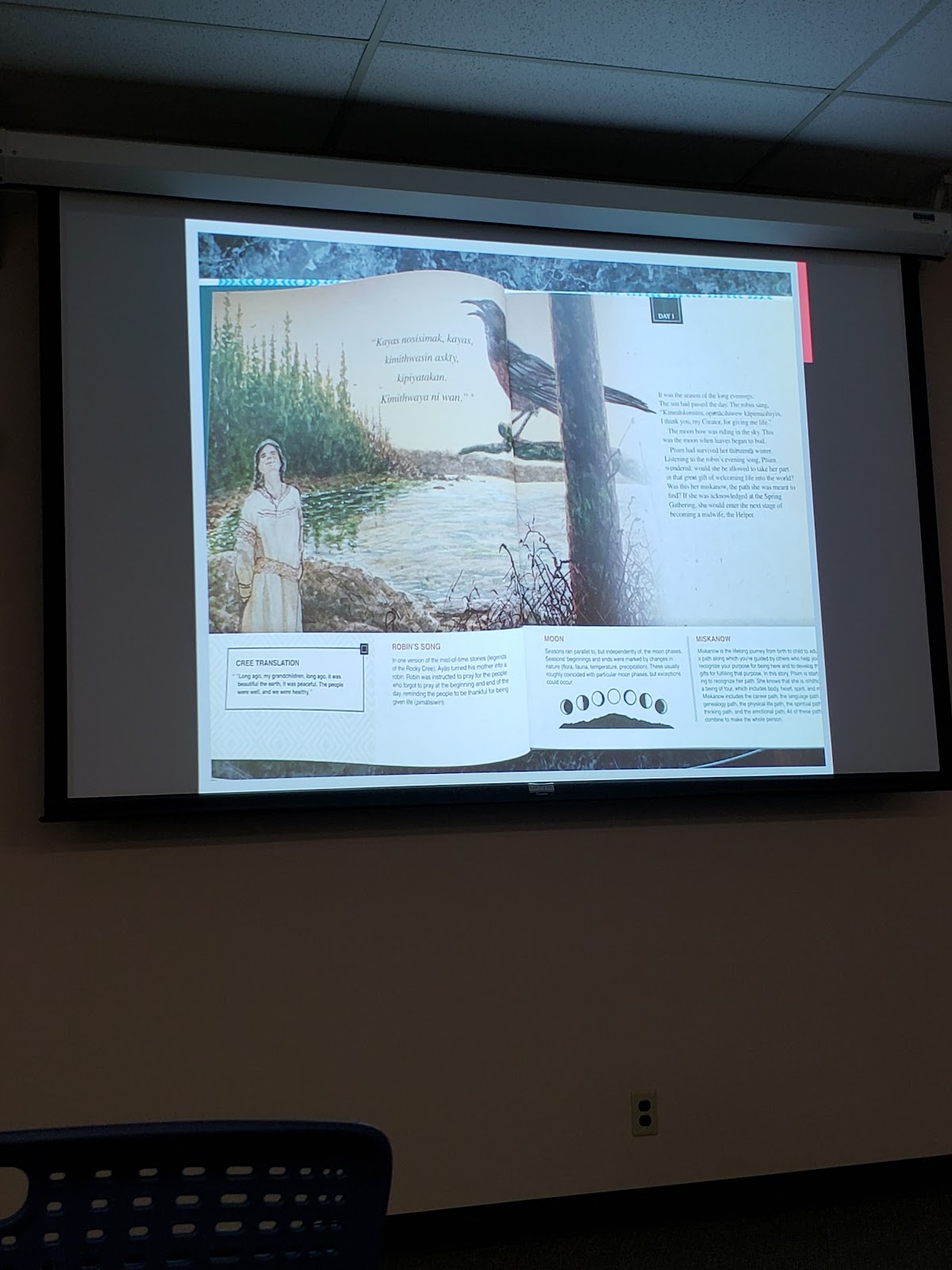
A page from the Pisim book that the app was based upon.
Unlike most museum
exhibits, in which viewers can look at but cannot touch the art object, Pisim
invites kids to immerse themselves in the object of their observation. Not only
are kids given reign in the story, through conversation with the Truth and
Reconciliation Commission of Canada, Dr. Hamer’s team involved Indigenous
children in the process of creating the app, and children are given
co-curatorship in the creation. Children are invited to help test the apps and
collaborate on early pilots. Indigenous children and teens are currently
testing her second application that is in progress.

The app’s narrator: a Cree elder.
Through this app,
there is remediation as a process of dialogue. Children at times are led to sit
and reflect on the content of the game and its real-life meaning. Turning oral
stories to applications allows for more access than going to someone from a
tribe, or going to a museum.
Dr. Hamer’s talk
highlighted the fascinating trend towards the “New Literacies” that are
developing for children. The screen has become a medium that transmediates
canonical texts and is also a place for experimentation of new content. It has
found its way into museums as an attempt for interaction, but still faces
limits as to user accessibility. The transmediation from book to screen remains
contested, but Dr. Hamer’s lecture revealed exciting possibilities for the
future of what counts as children’s literature.
-(SS) and (AN)


