Showing posts with label recommendations. Show all posts

Monday, February 11, 2013

Five Lessons from Children's Lit

I recently read an article on the five lessons adults can learn from Children's Literature. Consequently that got me thinking about what five lessons I might put out there. Days later, the task still loomed high above me--I've learned so much! How can I wrap that into five measly lessons?? Nevertheless a bit of whittling down resulted in the following. Though they don't encapsulate every important result of ChildLit (which is limitless, of course), they certainly hold meaning for me and explore a handful of lessons worth learning.

1. Curiosity -- How else do nearly all tales, children's or otherwise, unfold? With some healthy dose of curiosity. Alice must follow the white rabbit to Wonderland, Coraline must venture into the miniscule door to discover her Other mother, Harry and his cohorts must figure out what was in Gringott's Vault 713 that's so valuable. Certainly it doesn't always propel the story, but it lets the audience know that a bit of nose-poking and eye-peeking can lead to wild, amazing, even dangerous things, but if you keep your head about you, you'll make it through and straight to your next page-turning adventure.
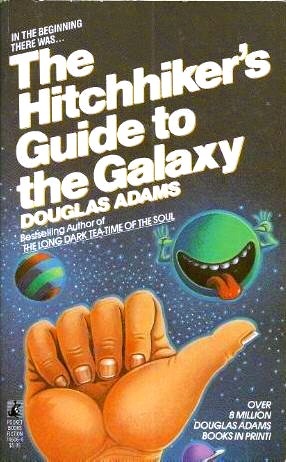
2. Flight! -- If I took anything away from The Hitchhiker's Guide to the Galaxy books, it certainly was the possibility of human flight. Well, that and 42. But according to Douglas Adams, flight can be achieved simply by falling... and missing the ground. It seems obvious, almost elementary. Why hasn't this been explored yet? Naturally, the physicist in us all will gently put this concept to rest in our heads as impossible, but for me it hints to something larger. Extraordinary feats are simply lying in wait amidst their ordinary exterior.

3. Identifying what you really need -- Knowing what you want is not the same as knowing what you want. Harry Potter knows Ravenclaw's Diadem is hidden in the Room of Requirement but actually identifying it is another challenge altogether. Fortunately for the Wizarding World, Harry does just that. In Stoneheart, George wants answers from an enigmatic Sphynx, but he needs to ask the right question, which proves trickier than he expects. Sometimes the biggest challenges are not the villains you chase or the fears you face, but simply puzzling out what matters most... and how to phrase it.
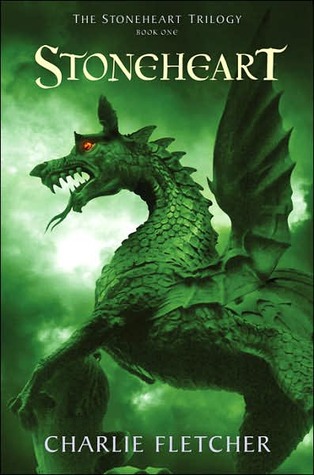
4. Perils (and perks?) of Vandalism -- I imagine it goes without saying that destroying property is wrong. It's disrespectful, harmful, costly and generally indicates violent, dangerous, or imbecilic behavior. In fact, break a stone dragon head off a building's exterior and you might awaken all the beastly statues of the city, inadvertently inviting them to hunt you down, as is George's dilemma in Stoneheart. No matter the consequence, we know that vandalism is punishable... unless it isn't. Being a child carries burdens, especially emotionally when the world lets you down (or you think you've let yourself down). A sudden rage to let out the pain might be needed; consider what Harry experiences in Dumbledore's office after the death of Sirius, and Rosalinda's breakdown upon learning exactly why she was left asleep for 62 years in A Long Long Sleep. We learn coping with trauma takes many forms, and occasionally a broken dish or twenty is necessary.

5. Time Travel -- It's going to happen. Just look at the necessity it breeds in When You Reach Me or A Wrinkle in Time. This life lesson is more of a demanding hope; just hurry up and make it real! Until it is proven impossible, we can still believe in the possibility and hope for its discovery. Above all else, hope allows everything else to blossom; its light sustains our existence.


What lessons from Children's Literature would you share?

Thursday, December 13, 2012

Books that Cast a Spell on Me

I'm a big fan of magic: fantastical worlds, untapped energies, roaring spells and philosophical beings that emerge due to a magical universe and reveal deeper elements of humanity. It's what gets my imagination racing with joyful adrenalin. I've shared before with friends, peers, and you that the magic of the Harry Potter series guided me back to children's literature as a whole to discover the possibilities in studying and pursuing it. All comes back to magic... And yet while reminiscing about some of my favorite books from childhood, I realized that the idea of magic without magic is a powerful component of many of my early books--the spells the stories cast was upon my imagination and creativity. So here I am sharing a few, just a handful, of books that I am indebted to for waking up different facets of fantastical thinking in my mind:

1. Bunnicula by Deborah and James Howe -- Long before vampires became the sparkly creatures of every teenagers dream, their mystique inhabited a little rabbit, raising the suspicions of the family's keen observant cat, Chester. As a child I adored rabbits and the intrigue of this tale played upon that love completely, making me much more curious, observant, and thoughtful about the ordinary people, places, and animals around me.

2. Mrs. Frisby and the Rats of NIMH by Robert C. O'Brien -- the ultimate presence of science astounded me, making the characters more accessible and memorable for me.  The balance between intelligence and the heart twisted around the idea of where magic resides, and the sweet protagonist mother mouse Mrs. Frisby has the coolest name too (who doesn't love frisbees? come on).

3. The Little Prince by Antoine de Saint-Exupery -- You know how he tames the fox, makes it love him and loves it back in return? Yeah, I may have tried that over and over again with the wild bunnies around our home when I was little. Perhaps it didn't work, but I certainly came to care for my little bunny more and more at least. That of course is just one of the epic reasons I love this story.

4. Frindle by Andrew Clements -- Okay I wasn't actually a child when I read this. It was my brother's and I must have been about 15 or so when I did. Nevertheless, it resonates with me always as the perfect depiction of the power of words, creativity, and idea formation in the real world. Plus, I considered time and time again what word would I want to create... still working on it.

What books wove magic spells and enchantments around you simply by their ideas? What shaped your imagination as a youngling? Do share! 


Tuesday, November 27, 2012

Notable Tales Rooted in Forests

Recently I read an article on The Guardian about the most notable or evocative presence of forests in literature, at least the most loved appearances from the perspective of the author, Sara Maitland. What matters in her compilation is that the forest exists as its own entity, overpowering the story and characters with both terror and delight. From children's to adult literature, she describes the magic of these forests, magic beyond a spell or wand. Do you agree with her choices? What would you add to the list? (For my part, I can't imagine leaving out Tolkien's Lord of the Rings series. The Ents!) Check out the article here.

Tuesday, October 23, 2012

YA and Child Lit on Immigrants and Hard Times

I came across a list of YA books at The Nerdy Book Club today on the immigrant experience that forced me to reflect on my own heritage and lack of awareness on the literature that best serves the needs of mine and my culture's identity. At some point in my adulthood I realized that even though as a child I had no problem identifying with my parents (hard-working, brilliant doctors who moved here from Pakistan before I was born), our faith, and our sometimes overwhelming culture/community, I never explored anything other than the mainstream literature easily nabbed and consumed at my school library or book stores. So I read it all, and certainly identified with many characters: shy or quiet book lovers, tomboys, middle children, wildly imaginative and twice as stubborn. But the cultural element was always absent. I look back now and wonder how it might have helped and prepared me to relate to "the experience" of the characters rather than only their "traits."
And now, with the direction world politics and dynamics have taken, I am curious what novels are out there for young adults from Muslim families, of Pakistani, Indian, or Middle Eastern descent.  Because I am still far too unfamiliar for my liking.

At any rate, this list was compiled to directly highlight the immigrant struggles of many cultures--Mexican(Crossing the Wire), Japanese (Farewell to Manzanar), and Sudanese (The Good Braider) to name a few. It is a compelling collection and one can still find solidarity and empathy reading any one of these novels no matter your own ethnicity. In fact, the description of each book includes a "common immigrant issue" and does well to narrow in on the pressures and pains particular to childhood. Find the list HERE.

~~~~
A separate issue, at times relevant to the immigrant struggle but certainly not exclusive to it, is economic hardship. An article in the Kansas City Star discusses one educator's work towards understanding children's literature and an economic education. As a result, Lynn Strover pulled together a short list of books that teach children about the value of money, the freedom it enables, and how to deal with hard times. For kids witnessing their parents' unemployment or the growing need to cutback on expenditures and luxuries, the lessons of these books may serve as a guide for them.  One example is:
Potato: A Tale of the Great Depression. Set in Kansas, this story by Kate Lied focuses on eight-year-old Dorothy who sets off for Idaho with her family in a borrowed car after her father had lost his job. Arriving in Idaho, they work day and night picking the potatoes that will help them survive the depression. In its own way, the story teaches children about the concepts of bartering and trading and getting by with little money.
The Harry Potter books are also featured, which makes sense considering the monetary system created solely for the books, as well as the banking system and issues of wealth versus lower economic classes that come up frequently.

You can view the article and the entire list HERE.

Read more here: http://www.kansascity.com/2012/10/19/3874614/kids-money-try-harry-potter-to.html#storylink=cpy

Wednesday, October 17, 2012

Tik Tik, the Master of Time

Something new on the global front: Announced as the first Pakistani Children's book to be (initially) published in English, Musharraf Ali Farooqi's Tik-Tik The Master of Time was just released on October 4th, becoming the author's third children's book. It tells the adventure of "two children from the planet Nopter who come to Earth searching for a way to grow up faster."Sounds exciting!

You can read more about it here. For more details about the book itself, check out the Facebook page.

Monday, October 15, 2012

Children's Books on Pinterest Boards

A little bit of fun to start off the week... Children's Books as featured on Pinterest!

For anyone familiar with Pinterest, the 15 boards listed on this site should tickle your senses a bit and remind you of the creativity that stems from simply loving books. For those not so familiar, here's a fun way to immerse yourself into Pinterest, where you can "pin" up all the goodies you find across the web and sort them into themed collections. This collection of boards, compiled on Delightful Children's Books, exhibits all sorts of fun, including edible books (my personal favorite), vintage children's lit illustrations and even book mobiles.

Monday, October 8, 2012

Lois Lowry on Dystopian Novels

For those who love Dystopian novels or those who have grown up on the books of Lois Lowry, her new novel Son, the fourth and final installment of the series that began with the critically acclaimed The Giver, should instantly have caught your attention.  This interview on Huffington Post with Lowry is a welcome window into the heart and mind of the author, where she discusses among other things the Dystopian genre and why she loves writing for children.

"Early on I came to realize something... That is, kids at that pivotal age, 12, 13 or 14, they're still deeply affected by what they read, some are changed by what they read, books can change the way they feel about the world in general... I think writing for kids is profoundly important."

Tuesday, September 25, 2012

Philip Pullman on Retelling the Grimms' Fairy Tales

"But my interest has always been in how the tales worked as stories. So I decided to retell the best and most interesting of them, clearing out of the way anything that would prevent them from running freely... I just wanted to produce a version that was as clear as water. My guiding question has been: 'How would I tell this story myself, if I'd heard it told by someone else and wanted to pass it on?'"
 An excerpt from Philip Pullman's essay “The Challenge of Retelling Grimms’ Fairy Tales” found in The Gaurdian. An insightful examination of the fairy tale and how to keep it "true to form."

Thursday, September 13, 2012

Reflections on Roald Dahl

Today would have been Roald Dahl's 96th birthday; children and adults alike celebrate his literary legacy today on what is also the 6th annual Roald Dahl Day. In keeping with that spirit, we share the following interview in The Huffington Post with Michael Rosen, former Children's Laureate in the UK and Dahl's "biggest fan" who recently wrote a biography of the author, Fantastic Mr. Dahl, aimed for children.


A thoughtful look into Dahl's continuing legacy can also be found in this piece in which Roald Dahl's widow, Liccy, talks about her husband's life.


Tuesday, September 11, 2012

Two thoughtful essays about 9/11

Today marks the anniversary of the tragic events of September 11, 2001. We invite our readers to read the essay below, written by former NCSCL director and SDSU Emeritus Professor Jerry Griswold for the Irish magazine "Inis," in which he discusses how things changed in his classes after the terrorist acts of 2001.

http://blog.parents-choice.org/2010/09/reading-differently-after-september-11/

Another thoughtful response to the events of 9/11, this time by the late great David Foster Wallace, is linked here:

http://www.rollingstone.com/politics/news/9-11-the-view-from-the-midwest-20110819

Saturday, April 7, 2012

The Irish Times Reviews Russell Hoban's Posthumous Novel, Soonchild, excerpt with thanks

The Irish Times - Saturday, April 7, 2012

Going for a World Song

YOUNG ADULT/TEEN FICTION: ROBERT DUNBAR has the pick of the latest young-adult novels

WITH THE DEATH, last December, of Russell Hoban, we said farewell to one of the most original voices in contemporary fiction. Whether in his picture books, his children’s novels or his writing for adults, Hoban never failed to challenge his readers with his imaginative narratives or his stylistic inventiveness, even if at times he may have seemed almost wilfully eccentric or obscure. His final picture book, Rosie’s Magic Horse, will be published in the autumn, but in the meantime we have Soonchild (Walker, £9.99), a short novel for young adults that acts as a poignant coda to the body of work that preceded it.

The notion of a coda is appropriate here, not just because this is a novel with its own haunting musicality but also because it takes song and singing as one of its central motifs. Set in the snowy landscapes of the Arctic, and imbued with numerous resonances of indigenous myth and legend, the narrative focuses on the situation confronting a shaman, known as Sixteen-Face John, and his pregnant wife, known as No Problem, when their imminently expected baby makes it clear from her mother’s womb that she will not be leaving there until she hears the “World Songs”.

John’s response is to embark on a hazardous quest to find this elusive music, a quest that takes him on a magical, mystical tour through a land of creatures great and small, of the living and the dead. Fear and darkness are everywhere, waiting to be overcome, in this wonderfully timeless and atmospheric story. Its pencil-sketch illustrations by Alexis Deacon and its extremely high production values make this a book as attractive to look at and handle as it is to read.

Friday, April 6, 2012

Peter Hunt on research resources in children's literature, reprinted with thanks from Oxford Bibliographies on-line

Childhood StudiesChildren's Literature
Peter Hunt

Introduction

The study of children’s literature as an academic discipline has developed since the 1980s from its roots in education and librarianship to its place in departments of literature and childhood studies. Although its practitioners position themselves at different points on the spectrum between “book-oriented” and “child-oriented,” the study is held together by the “presence” of some concept of child and childhood in the texts. The distinctions that apply in other literary systems between “literature” and “popular literature” or “literature” and “nonliterature” are not necessarily useful in this field. Nevertheless, criticism tends to fracture between a liberal-humanist and educationalist view that children’s literature should adhere to and inculcate “traditional” literary and cultural values and a more postmodern and theoretical view that texts for children are part of a complex cultural matrix and should be treated nonjudgmentally. In addition, the discipline is multi- and interdisciplinary as well as multimedia: its theory derives from disciplines such as literature, cultural and ideological studies, history, and psychology, and its applications range from literacy to bibliography. Consequently, children’s literature can be defined and limited in many (sometimes conflicting) ways: one major problem for scholars is that the term children’s is sometimes taken to transcend national and language barriers, thus potentially producing a discipline of unmanageable proportions. As a result, this article is eclectic, but it excludes specialist studies to which children’s books are peripheral or merely instrumental, such as folklore or teaching techniques. Children’s literature is also studied comparatively and internationally, with German and Japanese writing being particularly important. This article confines itself to English-language texts and translations into English.

Reference Resources

The major reference books (Carpenter and Prichard 1984, Watson 2001, Zipes 2006) are designed for the general reader, with succinct entries and extensive illustration. Hunt 2004, Hunt 2006, and Rudd 2010 are aimed at students of children’s literature and provide a basis for the study of the subject (see also Introductions and Guides). For the online resources, a distinction can be made between the academic International Research Society for Children’s Literature and the highly practical International Board on Books for Young People.

  • Carpenter, Humphrey, and Mari Prichard. The Oxford Companion to Children’s Literature. Oxford and New York: Oxford University Press, 1984.

    E-mail Citation »

    Although nontheoretical and increasingly dated, this pioneering work remains an essential text. The more than 2,000 entries cover authors, characters, books, themes, and genres and a selection of national literatures.

  • Hunt, Peter, ed. International Companion Encyclopedia of Children’s Literature. 2d ed. 2 vols. London and New York: Routledge, 2004.

    E-mail Citation »

    A two-volume collection of one hundred nineteen 6,000-word essays commissioned from world experts, including Iona Opie, Margaret Meek, Jean Perrot, Perry Nodelman, Hans-Heino Ewers, and Anne Pellowski. The text attempts to cover every aspect of the theory and practice of children’s literature; forty-six of the essays are concerned with the literature of specific countries, continents, or regions.

  • Hunt, Peter, ed. Children’s Literature: Critical Concepts in Literary and Cultural Studies. 4 vols. Critical Concepts in Literary and Cultural Studies. London and New York: Routledge, 2006.

    E-mail Citation »

    The ninety-nine reprinted essays in this four-volume set are the most important critical or theoretical statements about or discussions of virtually all aspects of children’s literature. The set includes work by almost every major critic writing in English; there are twenty sections, the largest being “The Theory Debate.”

  • International Board on Books for Young People.

    E-mail Citation »

    Information about contacts in seventy-five countries, devoted to the promotion and distribution of children’s books and to details of the international journal Bookbird.

  • International Research Society for Children’s Literature.

    E-mail Citation »

    The IRSCL website contains not only news about the society’s activities, but also information about conferences; calls for papers; a book review section; and links to children’s book collections, documentation centers and libraries, research centers, research societies, and other related sites across the world.

  • Rudd, David, ed. The Routledge Companion to Children’s Literature. Routledge Companions. London and New York: Routledge, 2010.

    E-mail Citation »

    Rudd’s Companion provides an extremely wide-ranging guide to the technical aspects of criticism and theory of children’s literature. The first half comprises eleven long essays on major themes and issues, such as gender, narratology, race, and young adult fiction; the second, an extensive annotated glossary of names and terms, a full bibliography, and a time line.

  • Watson, Victor, ed. The Cambridge Guide to Children’s Books in English. Cambridge, UK, and New York: Cambridge University Press, 2001.

    E-mail Citation »

    With more than 2,500 entries from more than 200 contributors, this encyclopedic volume covers books and authors that have “made a significant impact on young readers anywhere in the world.” There is particular emphasis on illustrators and on the importance of multimedia texts.

  • Zipes, Jack, ed. The Oxford Encyclopedia of Children’s Literature. 4 vols. Oxford and New York: Oxford University Press, 2006.

    E-mail Citation »

    Four-volume general reference work, with particular emphasis on biographies of authors and illustrators.

Sunday, March 11, 2012

From American Indians in Children's Literature, reprint

Sunday, March 11, 2012

Former Student in TUSD's Mexican American Studies classes: "Everything has been taken away..."

[AICL Editor's Note: Are you looking for information about the shut-down of the Mexican American Studies classes at Tucson Unified School District? A chronological list of links to AICL's coverage of the shut-down (can be found at AICL's website)]

_________________________________

Last month, students from California State University, Northridge (CSUN) traveled to Tucson in support of students and teachers in the now-banned Mexican American Studies classes that were shut down in January, 2012 by the Tucson Unified School District's (TUSD) board. For background on their visit, see the article in the CSUN student newspaper.

David Morales, who blogs at Three Sonorans, filmed students talking about how things have changed. Their day-to-day lives are ones in which they are followed and their assignments are collected by administrators:

Curtis Acosta is a teacher in TUSD. He taught in the now-banned classes and has been providing updates:

January 24, 2012
February 23, 2012
March 7, 2012

You can support the teachers, students, and their on-going efforts to get the program reinstated by donating to Save Ethnic Studies.

Posted by Debbie Reese at 7:57 AM

Tuesday, March 6, 2012

Russell Hoban's new YA novel, Soonchild, reviewed, The Guardian, reprint

This is a novel I'll be reading in a few weeks with my Adolescence in Literature students. I think it's one of Hoban's best, but he's a quirky writer. If you're reading the book, let us know what you think.

A.A.


Soonchild
By Russell Hoban (author) and Alexis Deacon (illustrator)

Hardback : 144 pages
Imprint: Walker Books Ltd; (1 March 2012)
ISBN-13: 9781406329919


Synopsis
Somewhere in the Arctic Circle, Sixteen-Face John, a shaman, learns that his first child, a soonchild, cannot hear the World Songs from her mother's womb. The World Songs are what inspire all newborns to come out into the world, and John must find them for her. But how? The answer takes him through many lifetimes and many shape-shifts, as well as encounters with beasts, demons and a mysterious benevolent owl spirit, Ukpika, who is linked to John's past...Legendary storyteller, Russell Hoban whisks his readers across frozen landscapes, to the edges of cliffs, into tiny rocky crannies, and down into the belly of a great swallowing demon - and has them laughing and weeping by turns along the way. Lyrical illustrator, Alexis Deacon meets the spirit of Hoban's vision head-on, and brilliantly captures the dark magic that lies at the heart of this fable.

Saturday, February 4, 2012

The Washington Post Recommended Books for Black History month, excerpt

For Black History Month, children’s books can be enlightening

DEB LINDSEY/FOR THE WASHINGTON POST


February is Black History Month, but you probably already knew that....

.... If you want to learn more about the experiences of African Americans in this country, here are some great books to explore — this month or any month.

“Just as Good: How Larry Doby Changed America’s Game” by Chris Crowe. $16.99. Age 6 and older.

Larry Doby was the second black man to play professional baseball in the major leagues. The first was the legendary Jackie Robinson. But in 1948 Doby, who played for the Cleveland Indians, became the first black man to hit a home run in a World Series game. This wonderful picture book tells the simple story of a boy and his dad listening to that game on the radio in their kitchen and realizing that they were listening to history being made.

“What Color Is My World? The Lost History of African-American Inventors” by Kareem Abdul-Jabbar and Raymond Obstfeld. $17.99. Ages 8-12.

Get ready to have your mind blown with this fun book. It tells the story of twins who discover the amazing stories of African American inventors whose creations changed your world. Don’t believe it? Do you know who George Crum, Alfred Cralle and Lonnie Johnson are? We’re sure you’ve used their products. Crum invented potato chips in 1853; Alfred Cralle invented the ice cream scoop in 1897, and Johnson invented the Super Soaker and got a patent on it in 1991. In the course of reading this book you’ll also discover that Charles Drew came up with the idea for blood banks, which have saved millions of lives, and that Frederick McKinley Jones came up with the idea for refrigerated trucks that allow food to be moved across country without spoiling. The book has lift flaps and fast facts that makes learning so quick and easy that you can’t help but have fun.

“When Grandmama Sings” by
Margaree King Mitchell. $16.99. Ages 5-9.

This is another picture book that tells a powerful story from a time before you were born. Belle is a young girl who loves her grandmother and knows that Grandmama has a beautiful singing voice. One summer Belle and her grandmother go on a tour with a jazz band. Belle sees how unfair it is that blacks and whites are separated. But she also learns that the beauty of her grandmother’s voice can help overcome those prejudices.

“Heart and Soul: The Story of America and African Americans” by Kadir Nelson. $19.99. Age 9 and older.

Kadir Nelson is an in­cred­ibly talented illustrator, and simply looking at the beautiful artwork in this book will give you a new understanding of American history.

— Tracy Grant