Showing posts with label interview. Show all posts

Friday, February 18, 2022

Meet Our New Graduate Assistant!

We are so excited to welcome our new Graduate Assistant, Dani Nouriazad! Graduate Assistant Natalie asked Dani a few questions to get to know them. Read more about it below!


Tell us a bit about yourself. How long have you been in the MA program? What are your scholarly interests? Are you teaching at the moment? 

My name is Dani Nouriazad. I’m in my second semester of the MA program, studying children’s literature with a special interest in queer studies and gothic/horror studies. I’ve been interested in the world of children’s literature for about three years now! I’m particularly invested in young adult literature, but find myself enjoying picture books and poetry for children more and more. I am also an instructor on campus, teaching RWS 200: Rhetoric of Written Arguments in Context, with special focuses on poetry, community, and radical movement. So far, we’ve enjoyed grappling with what makes poetry meaningful, and how it accomplishes that impact. It has been a challenge, but I’m enjoying all that I’m learning about what it means to be on the other side of the desk.


What do you like to do in your spare time/outside of school?


As an English major, I'm sure you won't be surprised by my answer: I love reading! Many of my favorite stories include gothic themes and horror tropes, queer characters, fantastical landscapes, and perhaps a cheeky, lovable sidekick for comedic relief. From graphic novels to picture books, if it’s got a little strangeness, I’ll love it.


Lately, I’ve enjoyed Jewell Parker Rhodes’s Ghost Boys, Anna-Marie McLemore’s When the Moon Was Ours, and Emily Lloyd-Jones’s The Bone Houses. I also love Gloria Anzaldúa’s Amigos del Otro Lado (Friends from the Other Side), Matt de la Peña’s Milo Imagines the World, and Marjane Satrapi’s Persepolis. I especially enjoy toting along a good book as I lounge in many of the beautiful parks San Diego has to offer, with a sweet caffeinated beverage steaming by my side. I also enjoy reading and writing for small independent zine creators and poetry presses, like local magazine SOFT Quarterly. Otherwise, I find myself going on long walks around town, thrifting, and consuming far too much local artisanal ice cream. 


What excites you most about starting as a graduate assistant for the NCSCL?


As someone who’s invested in our ability to transgress and disrupt the status quo, I am excited about working at the National Center for the Study of Children’s Literature, a great place to platform those voices and narratives that otherwise go unnoticed or unappreciated. The Center features so many diverse books and authors, it’s tough to choose just one world to explore at a time. The authors that the Center uplifts have shared stories that depart from the traditional narratives that we all know and appreciate. From offering LGBTQIA+ young adult protagonists to explorations of adverse experiences, like houselessness and addiction, the Center continues to add to the archive of childhood narratives, experiences, and subjectivities.


I’m certainly excited to have access to so much more material in the realm of children’s literature and to share what I learn with others. There is much to be gained from active study in this field, where we plant the ideas for movement makers, dreamers, and critical thinkers. It all starts with the kinds of access, information, and appreciation that NCSCL can provide. Whether it be book reviews, interviews, or sharing new and exciting releases, I’m thrilled to be a part of this team that continues the conversations in children’s literature. Being able to share it with anyone and everyone who finds the Center and our work intriguing is what makes it most worthwhile. 


[Image Description: Dani, wearing their hair down and in a leopard print top, holding up Gloria Anzaldúa's picture book, Prietita and the Ghost Woman, to show the cover. With the book covering the bottom half of their face, Dani is peeking over the book, making eye contact with the camera.]

Friday, October 8, 2021

Interview with Professor Lashon Daley

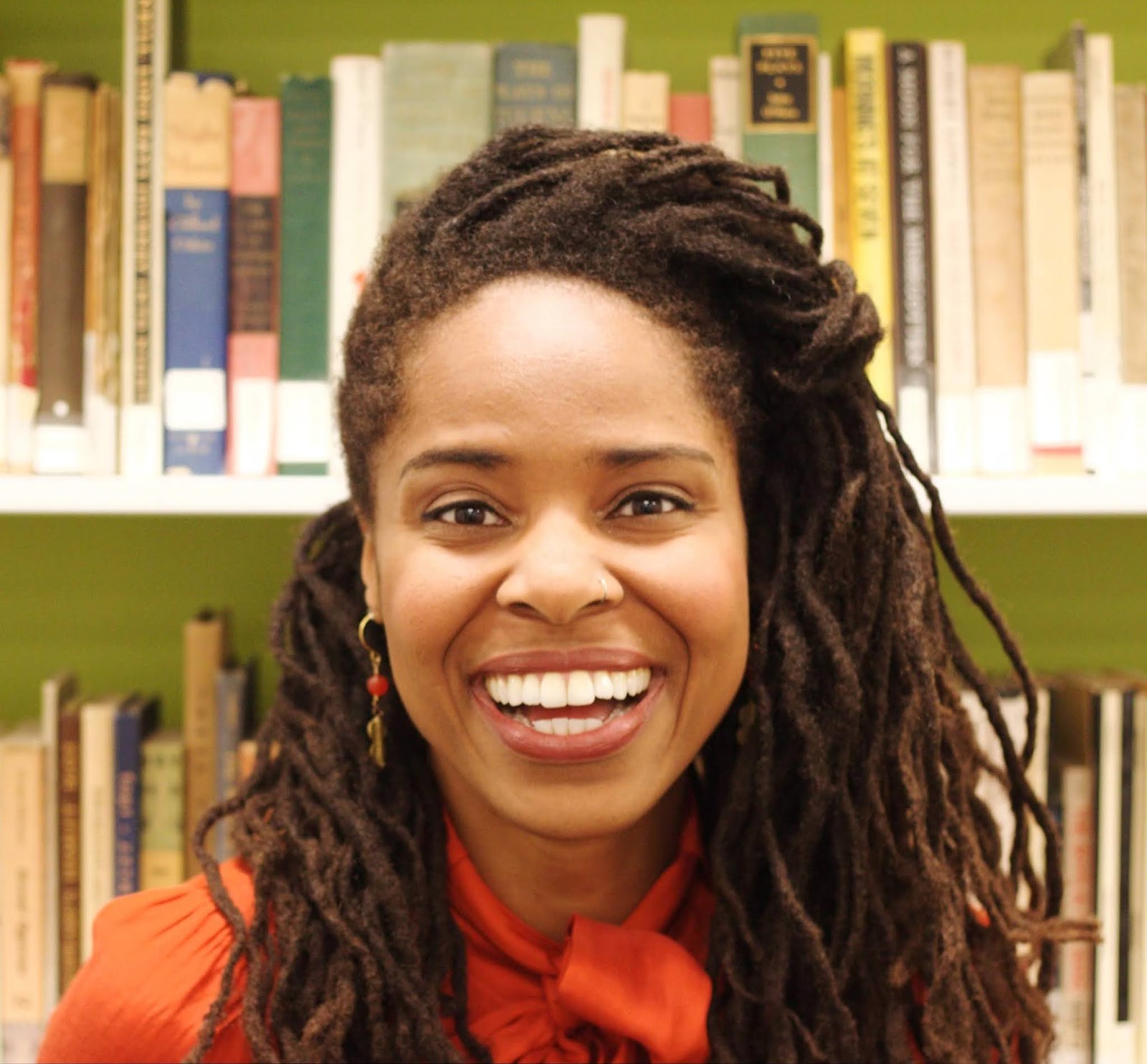
 The NCSCL is honored to present an interview with Dr. Lashon Daley, the Department of English and Comparative Literature’s new assistant professor of children’s literature. The interview was conducted online by Natalie Alvarez and Lara Amin, graduate assistants for SDSU’s National Center for the Study of Children’s Literature. We thank Professor Daley for taking the time out of her busy schedule to talk with us, and we’re proud of the opportunity to better acquaint our readers with our newest professor and her exciting work!


Tell us a bit about yourself: Where are you from? What were some of your favorite books as a child? How did you become interested in children’s literature and childhood studies, and what do you find particularly interesting about it?


I grew up in Miami, Florida, and spent most of my childhood climbing the mango tree in my backyard and the avocado tree in my front yard. As a result, I rarely read for leisure. Being outside and playing with my siblings brought me more joy than reading on my own. And to be honest, I hated reading. I preferred making up stories in my mind and telling them to my very attentive collection of stuffed animals. I did begin writing down my own stories when my mother gave me my first journal at the age of seven. I wrote my first children’s book shortly thereafter. It was about a blue rose that did not know how to bloom and had to learn on its own. 


When I eventually began to tolerate reading, I fell in love with serial collections like The Berenstain Bears by Stan and Jan Berenstain, Clifford the Big Red Dog by Norman Bridwell, and Spot by Eric Hill. In addition, I’ll Fix Anthony by Judith Viorst was also a favorite because it mimicked my experience of being the youngest child and allowed me to feel seen.


As you can see, my love for children’s literature was a slow burn. It finally caught fire when I was working as a marketing assistant at the Louisiana Children’s Museum in New Orleans. I had the privilege of working with my colleagues to implement children’s educational programs, and childhood literacy was a major part of our core mission. I had a running knowledge of what was popular in the industry, what books were used to hit literacy goals, and essentially what made a good children’s picture book. So, I decided to write my own. My children’s book, Mr. Okra Sells Fresh Fruits and Vegetables, was published in 2016 by Pelican Publishing, and it launched me into the industry in a new way. Performing the text at festivals and in classrooms made me even more curious about children’s literature. When the book was released, I was in my first year of my doctoral studies at UC Berkeley. Through a series of research pursuits, children’s literature, especially children’s literature as it intersects with Black girlhood studies, eventually became one of my research fields.


Children’s literature is a fascinating field of study because of its depth and breath. Essentially everyone from children, to parents, to educators, to librarians, to the top 

scholars within the field, to the illustrators, to the writers themselves all, play a role in expanding this field of study. The infinite possibilities of where this field can go means that I am limitless in my research. And for me, that is a beautiful place to be. 


When you applied to SDSU, what aspects of the university and the Department of English and Comparative Literature did you find most attractive?


While my Ph.D. is in Performance Studies, my heart has always been based in English and Comparative Literature. I received my BA in English, my MA in Folklore, and my MFA in Writing. So applying to the department felt like a homecoming for me. I was extremely impressed by my colleagues Phillip Serrato and Joseph Thomas, whose research interests are so fascinating. I felt that I was going to be among scholars who also remained curious and limitless in their approach to the field and to their research. I felt a strong connection to so many of the professors in the department, who are not only top scholars, but also creatives as well. Plus, the opportunity to work with, teach, and mentor English majors and minors is an absolute dream. 


What were the most significant challenges or obstacles for you during or post-graduate school?


When I was pursuing my MFA in Writing at Sarah Lawrence College, I had a desire to pursue publishing after graduation. I did not. However, that desire manifested itself again while I was preparing for my qualifying exams in the third year of my doctoral program. I was feeling so overwhelmed by the requirements of becoming a top scholar that I considered leaving my program. I began to research the job market in publishing and even applied for a position at a children’s literary publisher. I never told my advisor because I knew that she would talk me out of it. Once I passed my exams, I did feel much more confident in my ability to complete my degree. I am grateful that I persevered because now I have the opportunity to continue my research and to be in conversation with those within the industry. 


What seminars would you like to teach? Tell us about them and how they relate to your research. 


I would love to teach a seminar on research methods for fiction writers. Since I pursued my MFA before pursuing my PhD, I feel like I missed out on some crucial knowledge on how to conduct research for my creative master’s thesis. Being taught the craft of writing is super important, but I believe that teaching research methods in MFA programs would be a game changer. I am a really great example of why this is important. For my MFA thesis, I was writing a young adult novel about a Black girl coming to terms with heartache and grief after the tragic passing of her father. Now as a scholar at the intersection of children’s literature and Black girlhood studies, I feel much more equipped to write and construct a world for my character that is based in real-world research.


Which of your current projects excites you the most?


I have some children’s picture book manuscripts that I put on hold in order to complete my dissertation. I am excited about returning to those manuscripts. And then, of course, I am excited about turning my dissertation into a book.


What advice would you give to a student starting graduate school in 2022? 


When you wake up in the middle of the night with the perfect word or sentence for your manuscript, write it down immediately. You will NOT remember it in the morning. 


**


Thank you so much to Dr. Daley! We’re grateful to have the opportunity to showcase SDSU’s brilliant new professor of children’s literature!


- (NA) & (LA)


Thursday, October 3, 2019

Interview With Ashley Nguyen, Student


Sofia St. John had the opportunity to interview Ashley Nguyen, her fellow graduate assistant and a student of Dr. Mary Galbraith in 2018. We spoke about her experience working with Dr. Galbraith in her undergraduate class.


Image: screen grab: My Neighbor Totoro, Hayao Miyazaki from Dr. Galbraith’s English 501: Fantasy for Children syllabus

What class did you take with Dr. Galbraith, and when?

I took English 501: Literature for Children in the fall of 2018, and the theme was “fantasy and the touch of the real.” It was my first children’s literature class and I chose it to be my specialization course in preparation for the spring honors program. Of course, I was very excited! What was your favorite part about being in class with Dr. Galbraith? Dr. Galbraith was my introduction to a field I hadn’t even heard of before. It was fascinating to learn from someone who had excelled in the field for so long and still found new ways to talk and write about what she loves. This course was the first time I had taken a class in which I fell in love with the readings and knew I wanted to dig deeper – to read, discuss, and write more about children’s literature.

What was your biggest takeaway from the class? How did she impact your studies going forward as a literature scholar?

Dr. Galbraith emphasized authors’ backgrounds, claiming that their childhood experiences profoundly influenced the literature they would go on to create. We drew parallels between the authors’ life events and the events that their characters undergo. This concept has come to fruition in my own research a year later, as I am currently preparing for a ChLA panel on #ownvoices. Specifically, I am interested in how Asian American authors’ experiences as descendants of refugees influence their own writing, particularly in the creation of characters born in the United States.

How do your research interests overlap with Dr. Galbraith’s, if they do? If not, did you find any new research interests in her class?

Dr. Galbraith didn’t share much of her research interests, but I remember her telling us towards the end of the semester that she was writing (if I recall correctly) a definition for a dictionary. The term she was researching was “deixis.” I remember being floored by the complexity of her research, which she had never flouted throughout the semester. It was a moment when I realized the infinite possibility for the academic study of literature, which was formative for me as someone who was applying to a master’s program more out of necessity than passion for literature. I got my first look at the fun (and torture) of the life of a scholar, which I will develop into throughout my own studies as a graduate student.
I hadn’t had a specific research interest in mind, but her class provided an extensive survey of the different forms that children’s literature takes, including classics, novels, picture books, and animated movies. I was compelled by our early look at how fairy tales adapt over time, and this influenced the honors thesis I wrote in the following semester.

Does she have any unique teaching styles or aspects of her class which differ from other classes you have taken?

Professor Galbraith was very engaging and valued the input of her students, many of whom were not English majors. Her discussion questions and written assignments challenged us to think critically about books that are often relegated to the margins, as well as stories we’ve heard but never analyzed before. English 501 was notable because its texts explored a lot of difficult themes such as war trauma, adult condescension towards children, and parental abandonment.

Do you have a notable memory from class or from working with Dr. Galbraith?

The most heartwarming event I can recall occurred in the middle of the summer after I had taken her class. I had just graduated and was accepted to the graduate program, which I had asked her to write a letter of recommendation for. In July, I received an email from her which stated very simply:
Dear Ashley,
Congratulations on making the Dean's List-- that's a significant accomplishment!
Your proud professor,
Mary Galbraith

This email, to me, really sums up the kind of instructor Dr. Galbraith is. She remembered me from two semesters ago and went out of her way to send me an email and encourage me, whose accomplishments are incomparable to her numerous publications and international conference presentations. She is well-beloved to all who know her because she genuinely cares about others. SDSU is very fortunate to have a lecturer with such intellectual and emotional generosity.

Thank you so much to Ashley for helping us get to know Dr. Galbraith a little more!

This is part two of a series of blog posts in preparation for Dr. Mary Galbraith’s talk, "The Deictic Imaginary: Literature as Creation," to be held in LL430 on Wednesday, October 30th from 4:00-5:00PM. Please keep an eye out for part three to come out in a few weeks!

-SS

Thursday, September 26, 2019

Interview with Tishna Asim, Lecturer


Interview with Tishna Asim, Lecturer

September 24th, 2019


The National Center for the Study of Children’s Literature at SDSU had the wonderful opportunity to sit down with Tishna Asim, a lecturer in the Department of English and Comparative Literature. We spoke about the ways that her background has influenced her literary and teaching interests, and spent time discussing how Dr. Mary Galbraith’s teaching and mentoring informs Tishna Asim’s work in the classroom.

What Tishna Asim would look like as a Disney character!


Can you share with us your educational background? How did you get to where you are professionally?

I did my undergraduate Bachelor of Arts at Revelle College, University of California San Diego. I went to law school, and I got my law degree from University of San Diego. I practiced law for ten years as a trial attorney, mostly in criminal defense but also in dependency defense. And then in 2013, I hit pause on the law stuff mostly because I was tired of looking at autopsy photo – I wanted a break from some of that gruesome reality – and I enrolled here at SDSU in the Masters program in 2013. I got my Master of Arts with a British Literature specialization in 2016 and started teaching as a lecturer in fall of that same year here at SDSU. My research focus in the graduate program was Victorian crime fiction specifically, and then even more specifically it was on Sherlock Holmes, and that’s probably because of my former career – you know, law and literature. You can take the girl out of the courtroom but you can’t take the courtroom out of the girl.


And you’ve been a lecturer at SDSU since?

Since the fall of 2016 so this is my fourth fall semester.


What are your research interests? 

I’m really interested in the Gothic; I’m really interested in the horror genre to the extent that it overlaps with the Gothic and how it overlaps – all of those overlap – with crime fiction. I’m really interested in mystery and the detective genres as well. But I also really like fantasy. So Tolkien, and C.S. Lewis, and of course Harry Potter. So to the extent that the children’s literature sometimes is represented in those specifically fantasy genres, I’m really interested in that. And other YA literature as well.


You teach English 306A, a children’s literature course for Liberal Studies students. What is it like working with students who will use children's literature in their own classrooms?

The theme of the class has varied a tiny bit over time. Right now, it’s evolved into examining Gothic within children’s literature, so Gothic themes, Gothic subtext, Gothic tropes in a place that you wouldn’t necessarily expect to find it: i.e. children’s literature. But I’ve also been interested in framing how child detectives work, in examining their world, so I’ve had a detectives class within children’s literature as well. In fact, if you turn around, you’ll see those are the texts that I’ve taught: Encyclopedia Brown, and Nancy Drew, and The Great Mouse Detective, and The Eleventh Hour, which is this gorgeous book. Every single page is covered with sumptuous illustrations and it’s a curious mystery to figure out who stole the birthday cake at a little eleventh birthday – it's so cute.


The poster mentioned above. 


But mostly I teach those themes as a way of investigating that the child psyche is as complex as the adult psyche, and to dumb it down for children is a disservice to them and doesn’t allow for them to have the same complexity as an adult would, which I think is ridiculous.

Teaching Liberal Studies students in particular has been very rewarding in the sense that a lot of the texts we examine become texts that they use themselves in their classrooms, or with children they encounter, siblings, or their own kids, or classrooms where they are already teaching. And I often ask the question of whether or not the text that we just completed is actually for children, even though it’s marketed to them. So there’s this distinction between capitalist marketing and whether or not this is something the kids should be digesting – and then that invites the question of censorship. What do we expose our kids to? What do we allow them to be exposed to in a classroom, in a bookstore, et cetera? And so that perspective is really valuable because they as future teachers are so rigidly boxed-in to what is allowed in the classroom and texts that are supposedly safe for kids might actually reveal subtexts that are really quite problematic, or emotionally charged, or sexual, or violent, et cetera. Little Red Riding Hood is a great example.


What is it like to create syllabi each semester? Do you often reuse books or create completely new ones?

80% of the books are ones that I’ve already taught, but every semester I include at least one new text mostly to keep me engaged. It’s something new to see ‘hey does this work’? So I do change it up every semester in all of my classes, even in my Intro to Literature 220 class, just because I don’t want to get bored.


Can you share one notable teaching experience here at SDSU?

Every day I don’t have to go to court is a notable teaching experience! They’ve all been really rewarding. And certain semester the students are – this semester in particular – the students are very engaged. They want to talk; they want to hear from each other and get that global perspective within thirty different opinions and voices in the classroom – thirty-one if you include mine. So it’s always really, really rewarding when students are as engaged as I am because I care about this. I think it’s fun, and when it stops being fun is when I’ll stop teaching. And I’ll go back to court.


What is your experience working with Dr. Mary Galbraith?

She taught a class when I was in my last semester in the graduate program on adolescence in children's literature, or adolescence in literature, or something like that, and it was fascinating because there were texts that we wouldn’t have considered to be adolescent texts at all: specifically Hamlet, and Their Eyes Were Watching God. These characters are ostensibly in their twenties and yet they embody the adolescent perspective, whether it’s through naiveté or a lack of life experience or in the case of Hamlet, he’s been so protected by his role as a prince. And we talked about development in ways I hadn't considered before. Her class was just so intriguing because it invited, it required, an alternative perspective on what is adolescence in the first place. So already you were challenging your own preconceived notions even about the theme of the class before the class even started, which I thought was brilliant. We continued to have that subversive, unsettled perspective throughout, which I thought was really refreshing. It wasn’t her lecturing at us about ‘you know this book was written in such-and-such year and this was happening and that was going on.’ It was really just an opportunity for us to totally take a text that we thought we knew about and shift it. What would it be like if Hamlet was actually sixteen? That’s kind of how it is if you read it now. Now I can’t not see him as an adolescent. But her class was so open to listening to all of our perspectives. She brought in guest speakers that spoke very eloquently about books even though they weren't traditional academy members, which I thought was great. We read lots and lots of cultural texts that again gave us that new chance at shifting our perspective. I thought she was fascinating as a professor because her own life has been marked by different landscapes and living in different places. Just being a sort of global citizen. She lived in England at one time and when I took her class, she had just come back from a sabbatical in England where she was walking in the footsteps of Dickens. It was so cool; she’s so cool. She knows what she’s doing; she knows what she’s talking about. Her units on chapter books and picture books are really empowering to the reader because there aren't a lot of wrong answers, which I think is a great thing about the humanities in general. If you have evidence, you get to be right.


Have you been able to interact with her a lot as a colleague?

Not as much as I’d like. We teach at around the same time, so we’re kind of ships passing in the night. If I see her, it’s just catching up on personal stuff, which is nice. She’s still a great mentor and role model for me on how I want to do this work. She publishes a ton. She’s pretty prolific. I think she published three articles last year. She’s busy engaging with these questions that don’t go away. Even after the child who reads this book becomes an adult, it still has impact. And she’s tracing that in really cool ways. She’s really smart.


Thank you so much to Tishna Asim! We’re grateful to showcase one of the many brilliant instructors teaching children’s literature at SDSU.

This is part one of a series of blog posts in preparation for Dr. Mary Galbraith’s talk, "The Deictic Imaginary: Literature as Creation," to be held in LL430 on Wednesday, October 30th from 4:00-5:00PM. Please keep an eye out for part two to come out next week!


 - (AN)

Tuesday, June 19, 2018

Pilot Podcast Interview ft. Dr. Krystal Howard and NCSCL Director Dr. Joseph T. Thomas Jr.

Hey Everyone!

We here at the NCSCL have enjoyed interviewing all of the fantastic guest speakers that have visited this last academic year. In an effort to keep innovation going, we decided to do something a little different in our interview with Dr. Krystal Howard and made the NCSCL Podcast! Our first episode is the recorded interview between our director Dr. Joseph T. Thomas Jr. and guest Dr. Krystal Howard and following her talk on the pedagogical impact of verse novels.

Being that this is the pilot, there is still a lot that we want to work on and improve in the future. Please comment and let us know what your thoughts on this type of project are--what works, what can be improved, what you would like to see in the future, if you would like more of this type of content--so we can keep growing as a center.

Here is the link for the Podcast (and to our SoundCloud account if you want to follow us there). Below is the embedded version. We hope you enjoy!


Friday, October 20, 2017

Interview: Dr. Phillip Serrato, leading Professor on Gothic and Horror in Children's Literature at SDSU


Shortly after the round table discussion in early October, NCSCL's Graduate Assistants, Andrea Kade and Chris Deming, spoke with Professor Serrato about the recent panel event and how the children's literature program evolved over the years. We learn how an intellectual restlessness motivates his evolving research interests and discover what "strange things" are taking place in his classroom. 


Position: Associate Professor & Undergraduate Director, San Diego State University
Places of Education: University of California, Riverside (BA, MA, Ph.D.)
Teaching Experience: Fullerton College and San Diego State University

Andrea: You recently participated in a round table discussion with other SDSU children’s literature professors. Can you tell us how you and your colleagues influence each other’s perspectives? Is there any moment during the discussion that stood out in your mind?

Professor Serrato: I think our children’s lit faculty inspire each other in many ways. When we find out or realize the different, innovative approaches everyone is taking, it’s invigorating, or at least it is for me. It makes me want to be a better scholar and a better teacher, and it energizes my excitement for our children’s literature program overall. Panel discussions like the one held last week make me want to explore the new territories that I see my colleagues delving into. It also underscores just how brilliant my colleagues are, which leaves me feeling like I have a lot of catching up to do! One of the highlights of that roundtable discussion was its demonstration of our children’s literature program as a multifaceted one distinguished by an array of interests that include childhood studies, queer YA, gothic and horror, and aesthetics. I’m hoping the audience at the panel walked away with a sense of the vibrancy of our program as well as a sense of the vibrancy of children’s literature as a field of study. 

During the conversation I got to thinking again—and I say again because it’s an idea I’ve brought up with classes at different points—about the difference between children’s literature and literature for children. The phrase “children’s literature,” is generally taken to suggest a specific audience…indeed, the organization of a literature around a particular audience. But when Dr. [Joseph] Thomas began talking about aesthetics—the recognizable tropes and features by which one can identify children’s literature—it got me thinking about the ways in which one can disarticulate concerns about audience. Talking about children’s literature as a genre can be separate from discussing literature for children, which by virtue of the preposition “for” entails a particular audience. This opens the door to treating children’s literature as any other type of literature.

Andrea: How has the children’s literature program changed over your tenure here at SDSU?

Professor Serrato: I’ve been here for 12 years and in that time it has changed quite a bit. Alida Allison, June Cummins, Jerry Griswold, and Carole Scott all welcomed me into this program but have retired. Personally, I miss them dearly. As a program we miss their specializations in areas like international children’s literature, classic American children’s literature, Jewish-American children’s literature, and picture book theory. We haven’t been able to fully restock our faculty roster—note to SDSU: we need more English & Comparative Literature faculty!—but we have been able to bring in Dr. Joseph Thomas and most recently Dr. Angel Matos. We’ve thus managed to gain expertise in areas like children’s poetry, fan fiction, and queer YA.. Our program has been transformed but the vibrancy remains. Indeed, one of the nice things about our children’s literature program—which in all honesty is emblematic of the English & Comparative Literature department at SDSU--is what I like to call the “intellectual restlessness” of my colleagues. Our faculty is moving into different fields and different directions all the time. This is why our department is constantly producing new and exciting forms of scholarship and offering new types of courses.

Chris: You mentioned at the panel that you had shelved a research project on Chicano masculinity and moved into a completely different area. Describe to us what brought about this sudden change and what your new project is about? Did it stem from the sort of “intellectual restlessness” that you mention before?

Professor Serrato: Well, I wrote my dissertation on masculinity in Chicanx literature, film, and performance. The usual route one follows when publishing one’s first book is to expand and revise the dissertation. But by the time I filed my dissertation, I was already moving on to other projects and into other areas. When I first came to SDSU most of the research work I was doing and which I continued to do was in Chicanx children’s lit. Over the past 5 or so years, I’ve been increasingly veering toward gothic and horror studies—a research interest that I’ve harbored since my undergraduate days. For years, though, I had been holding myself to the expectation that I would turn the dissertation into my first book. One day a year or so ago I was talking with my friend and colleague, Dr. Michael Borgstrom, about the masculinity project and I must have been talking about it in very lukewarm terms because he simply asked/told me, “Why are you working on that when your intellectual energy right now is in gothic?” This was tremendously liberating because I had been illicitly asking myself the same question! In that moment I committed myself to the book on children’s gothic, which I had actually already begun plotting, and I haven’t looked back. At the moment, I am thoroughly enjoying the research and writing that I am doing.

Andrea: It must feel good to be given a second validation, that it’s okay to let go of something you’ve spent so much time on to pursue an area that you are really passionate about.

Professor Serrato: There was definitely a guilt built into the shelving of the masculinity project. On the one hand I already had a lot of material completed in the form of the dissertation and the revision work I had already undertaken. On the other hand, masculinity in Chicanx literature and film is an important subject to address. But perhaps because of intellectual restlessness I was already moving onto something else. Gothic and horror are intrinsically fun and fascinating. To be able to focus on this as a scholar and teacher is an exhilarating next move for me to make in my career, and I’m grateful that in this department I have the opportunity to do so.

Chris: You’ve discussed in the past that you were an astrophysics major before switching over to English and literature. What aspects of literature drew you into switching majors? Do you pull any of your scientific background into your research today?

Professor Serrato: For me, there is not much disparity between astrophysics and literature. Initially, what drew me to astrophysics is the same thing that draws me to literature. Both provide an opportunity to have profoundly beautiful and philosophically powerful aesthetic experiences. In astrophysics, you’re exploring the cosmos and in literature it’s prose and poetry and imagery and ideas. When I initially declared astrophysics as my undergraduate major, it was a result of my high school not presenting the humanities as a viable career option. But I knew I loved literature. John Steinbeck’s The Grapes of Wrath, which I read my sophomore year in high school, showed me that literature can be affectively stirring as well as critically powerful. I struggled between my childhood love for astronomy and my interest in literature, but as I always tell students, “the rest of your life is a long time, so you better make sure you like it.” When I give that advice, it emanates from my own experience. Making the switch was the best thing I ever did.

Now, in literary studies we are always pulling from different disciplines, like psychology and sociology. Calculus and physics just happen to be other fields from which I draw when studying or teaching literature. It is worth noting that scientific language is built into literary analysis in a lot of ways anyway, like when we talk about narrative trajectory or polyvalence. Sometimes I just might go a little bit further conceptualizing things vis-à-vis calculus or physics.

Andrea: This semester you are teaching an undergraduate course, Stranger Things. Can you tell us more about this course?

Professor Serrato: (breaking into a grin) It has been a fun, exhilarating course! The students I have are brilliant and an absolute joy. I hope they know how much I admire and appreciate them. They are coming up with these great ideas that hadn’t even occurred to me and this is making the show even more interesting and meaningful. I keep telling them, “I don’t know about you, but I’m learning a lot!” I don’t know if a professor is supposed to say something like that, but it’s the truth. Collaboratively we’ve managed to come up with great insights into the show by bringing to bear upon it multiple approaches.  We’ve talked about the gothic literary tradition, the queer child, the archaic mother, the bourgeois family. Being able to explore the show through the lens of diverse aesthetic, critical, and theoretical methodologies has allowed us to realize a complexity and significance to the show that people might not ordinarily attribute to a television series.

One of the most interesting aspects of this show is how it’s reminiscent of gothic fiction. A lot of early gothic is set in some kind of remote past yet reflects contemporaneous issues. With Stranger Things we have a 21st century TV show set in the 80s, which I guess for young people is a remote past, but speaking to our contemporary moment. We are thus looking at Stranger Things not as an exercise in nostalgia, but as a text that speaks to current issues like surveillance culture and the modern family. In short, it is interesting how the show turns to the past to speak to the present.

Andrea: And you are including in the course season two of Stranger Things even though it won’t come out until the end of October. Do you expect any challenges from not having access to the material ahead of time?

Professor Serrato: We are having a viewing party on October 27th when we will all watch the first episode of the new season together and thus begin the work of figuring out, together, what we are going to do with it. Going into the semester I had sketched out a lot of themes and ideas that I wanted to touch upon for the first season, which I had already seen multiple times. But going into season two, I have no idea what to expect or what I’ll be teaching. It’s really going to be an exercise in “let’s make it up as we go along.” But I am optimistic that it is going to go well on the basis of the ambition and sophistication with which these students have approached the first half of the semester. We will see how themes from the first season are extended and what new themes and issues arise. At the very least, on the basis of the trailers that we’ve seen, season two looks promising.

Chris: Seems like a really unique opportunity for them, especially since the gothic is all about the unknown and now you are confronting the unknown in the form of an unreleased season of brand new episodes.

Professor Serrato: That’s actually a really good way to put it.  In the process what will hopefully get modeled is the fact that literary analysis and textual studies are not about the acquisition of pre-developed knowledge and insight. It’s about generating readings of texts as we encounter them. With season two we will be in the position of collaboratively seeing what we can do with a text—actually, a series of episodes—that we are all encountering for the first time. I’ve lucked out because one couldn’t ask for a better group of students with whom to attempt this type of a teaching/learning approach.

Andrea: As a teacher, scholar and parent, can you provide any advice for those in a similar position, or for students who struggle to balance work, school, and social/family life? Any obstacles you have had to personally overcome?

Professor Serrato: One always has a multitude of obligations that one is trying to tend to and an assortment of goals and ambitions that one wants to pursue, so one always tries to strike some kind of balance. Ultimately, you never figure out how to strike that balance, and the best you can hope for is doing the best you can—as cliché as that sounds. If one can establish a routine, as precarious as routines always are, I think that is your best shot at trying to meet your different responsibilities.

For me this means making time to advance my research, complete class prep, take care of undergraduate director duties, take my younger son to and from school, help both sons with homework, take care of domestic chores like dishes and the yard, and overall just be responsible to my students, my colleagues, and my family. All the while, I try to get in a run or a bike ride because being a literature professor and researcher is not a healthy lifestyle owing to the amount of time we have to simply sit down and read and write. For me certain things are non-negotiable, like family movie time and pizza night. I’m also adamant that as devoted as I am to my work as a professor and researcher and ECL colleague, my family never feels second to my work. Years ago when I was a graduate student I remember reading some scholarly monograph in which the author concluded his acknowledgments thanking his children whose “lasting impression of their father,” he said, “would be of him hunched over his computer.” When I read that I just thought, “No.”

Whatever one’s situation, one has to try to organize one’s time according to the priorities that one sets for oneself. I haven’t exactly figured out how to do this…I just keep trying on a daily basis. Every day, though, I am grateful for the opportunities I have and for the people around me and I try to be as helpful and productive as I can.

Chris: Are there any books you’d recommend to those who are interested in the fields you study or for any other reason?

Professor Serrato: With regard to children’s gothic, Anna Jackson recently edited a collection titled New Directions in Children’s Gothic: Debatable Lands. It’s a good start for getting a sense of the type of scholarship that is going on in the field. Also, anything by Chloe Buckley, who has what sounds like a fascinating book on children’s gothic coming out November 30. For horror studies right now I’m really into the work of Xavier Aldana Reyes. And as regards Chicanx children’s literature the work of U.S. poet laureate Juan Felipe Herrera, especially his verse novels Downtown Boy and Cinnamon Girl, and the poetry collections of the late Francisco Alarcón I always find dazzling and recommend to people. For “fun” I’m really into Semiotext(e)’s Interventions series. And I’m trying to wrestle with flarf poetry in the form of the aptly titled Flarf: An Anthology of Flarf, which is something Dr. Thomas made me aware of. The pleasure of these titles is that they push me to think in more expansive, more unfamiliar ways, which I guess appeals to that intellectual restlessness I keep mentioning.
 ____________________________________________

Has literature always been your passion, too? Contact Dr. Phillip Serrato at pserrato@mail.sdsu.edu if you're interested in switching majors or to ask questions on how to obtain an undergraduate degree in English at SDSU. For more insight into Professor Serrato's research interests, check out the list below for selected publications. 

“A Portrait of the Artist as a Muchachito: Juan Felipe Herrera’s Downtown Boy as a Poetic Springboard into Critical Masculinity Studies.” Voices of Resistance: Essays on Chican@ Children's Literature. Ed. Larissa Mercado-López, Laura Alamillo, and Cristina Herrera. Jefferson, NC: McFarland, 2018. (in press)

“‘These are troublesome, confusing times’: Darren Shan’s Cirque du Freak as Post-9/11 Gothic.” New Directions in Children's Gothic: Debatable Lands. Ed. Anna Jackson. New York: Routledge, 2017.

“You’ve Come a Long Way, Booger Breath: Juni Cortez Grows Up in the Spy Kids Films.” Critical Approaches to the Films of Robert Rodriguez. Ed. Frederick Luis Aldama. Austin: U of Texas P, 2015.

“Postmodern Guacamole: Lifting the Lid on El Tigre: The Adventures of Manny Rivera.” Latinos and Narrative Media: Participation and Portrayal. Ed. Frederick Luis Aldama. New York: Palgrave Macmillan, 2013.

“Ready or Not: Antonio Márez y Luna Is Thrown into the World of Rudolfo Anaya's Bless Me, Ultima.” Critical Insights: Coming of Age. Ed. Kent Baxter. Ipswich, MA: Salem P, 2012.

“Transforming Boys, Transforming Masculinity, Transforming Culture: Masculinity Anew in Latino and Latina Children’s Literature.” Understanding the Disenfranchisement of Latino Males: Contemporary Perspectives on Cultural and Structural Factors. Ed. Pedro Noguera, Aida Hurtado and Edward Fergus. New York: Routledge, 2011. 

“‘What Are Young People to Think?’: The Subject of Immigration and the Immigrant Subject in Francisco Jiménez’s The Circuit.” The Oxford Handbook of Children’s Literature. Ed. Julia Mickenberg and Lynne Vallone. New York: Oxford University Press, 2011.

“Promise and Peril: The Gendered Implications of Pat Mora’s Pablo’s Tree and Ana Castillo’s My Daughter, My Son, the Eagle, the Dove.” Children’s Literature 38 (2010).