Showing posts with label language. Show all posts

Tuesday, September 10, 2019

I Love You So Mochi by Sarah Kuhn


On my first day in the NCSCL office, I did what any avid reader would do: pull book after book off of the shelves in search of something that would fill the next seven hours “productively.” Sarah Kuhn’s I Love You So Mochi was an instant eyecatcher, a bright splash of pink amid book spines in varying shades of blue and black.


For this Vietnamese American, the title’s mention of mochi and the cover’s gorgeous background of cherry blossoms evoked a further attraction: a sense of affinity with the novel. As I read the dust jacket flap, I was introduced to one of the novel's most intriguing aspects – its juxtaposition of relatable Asian American teenage experience with unexpected subversions of the expectations that are imposed upon that identity. 


The novel depicts Kimi Nakamura, an American high school senior whose painting talent has guaranteed her early admission to a prestigious art school. The stereotypical Asian American parent’s distaste for any non-STEM/medical field career would seem to be the main conflict in the story, but it is not. Rather than disappoint her parents, this accomplishment is a great source of pride for her Japanese-born, American-educated mother, who is only recently able to pursue her own dreams to be a famous Asian American artist. Her fourth-generation Japanese American father runs a restaurant that “features ‘the best of Japanese, American, and Japanese American comfort food’” (23). But even with supportive parents, whose careers convey a well-balanced blend of Japanese and American identity, Kimi is completely uninspired to paint. When she receives a plane ticket to Japan from her estranged grandparents, she leaves her problems behind to explore her motherland. Kimi teams up with a (cute) aspiring doctor whose knowledge of the sights of Japan help her figure out what she wants to do with her future. As Akira takes her to different locations such as a bamboo forest, a temple, and a pug cafe, Kimi finds the courage to face the problems she had wanted to leave in America. And alongside her, the reader learns much about Japanese culture, customs, and sights.

What I appreciated the most about this novel was that Kimi experiences Japan as a tourist. Kimi knows very little Japanese. Her lack of etiquette knowledge makes for an embarrassing commute and immediately strains her relationship with her grandmother. She recognizes immediately the disjuncture between nature and nurture in identity formation: “It strikes me how discombobulating it is to be in a place where so many of the faces look like mine, but where I clearly don’t belong” (51). Even so, Kimi’s actions expose readers to Japanese interpersonal relations: small bows as greetings, use of last names with strangers, and even slang for cluelessness.

I Love You So Mochi’s treatment of language is one of its most striking aspects. Kimi is fortunate that her grandparents and Akira speak English well despite never leaving Japan, but they mix Japanese terms of assent such as “hai” (80), “sou da ne” (102) and filler words like “eto” (81) and “ano” (106) into their otherwise English conversation. Akira even describes “gairaigo––loan words. There is quite a bit of Japanese-style English” (100). The reader can easily pick up Japanese vocabulary without a dictionary, and nothing comes off as overtly didactic.

Additionally, food – be it shrimp burgers from Japan’s McDonald’s, a secret stash of limited-edition Snickers, or peanut butter and chocolate mochi from her father’s restaurant – helps Kimi find common ground with the people she wants to get to know and experiment with what is unfamiliar.

This novel is a delightful journey through a young girl’s search for her own identity in the land of her heritage. Her sketchbook accompanies her everywhere she goes, and her descriptions of clothing provide insight into her moods, values, and dreams. With each deepening relationship, Kimi investigates how determination, culture, and her own family’s history shape the future she wants for herself. Readers will delight with each step Kimi takes, whether running from deer, strolling with her crush, or towards her real passion.

- AN


Monday, May 27, 2013

Children's Literature in English Language Education Journal Available in Open Access Format Online

The debut issue of the CLELEjournal (Children's Literature in English Language Education Journal) is available online.

CLELEjournal is a peer-reviewed, biannual, and open access journal dedicated to examining the use of children's literature in teaching English language. The first issue features the following articles:
  • "The World Turned Upside Down: Exploring Alternate History with Young Adults" by Justyna Deszcz-Tryhubczak & Mateusz Marecki
  • "From Reading Pictures to Understanding a Story in the Foreign Language" by Annett Kaminski
  • "Humanizing Teaching English to Young Learners with Children's Literature" by Irma Ghosn
  • "Playing with Nonsense: Toward Language Bridging in a Multilingual Classroom" by Urmishree Bedamatta
  • "Response to 'The Lost Thing': Notes from a Secondary Classroom" by Sandie Mourão
Visit http://clelejournal.org to read these articles and learn more about CLELEjournal.


Wednesday, February 6, 2013

CFP: Cultural Minorities in Children's Literature and Verbal Culture Conference in Iceland

This is an invitation to participate in the campUSCulturae network and a third Call for Papers for the conference:

Cultural Minorities in Children's Literature and Verbal Culture

April 24th and 25th 2013, in Reykjavík, Iceland

Arranged by The Vigdís Finnbogadóttir Institute of Foreign Languages, University of Iceland in cooperation with:

- The campUSCulturae Network
- The Nordic Culture Fund
- The Committee for Nordic Studies Abroad

We invite the submission of papers in the field of cultural minorities in children's literature and other verbal culture, as well as related fields.

The conference will have two central themes which may be divided into separate seminars:
• Minority Children’s Literature versus Global Popular Culture
• Children's Culture and Roots of Minorities


Keynote speakers:

Minority Children’s Literature versus Global Popular Culture
• John Stephens, Emeritus Professor at Macquarie University, Australia
• Karin Langgård, Associate Professor at the University of Greenland, Nuuk
• Turíð Sigurðardóttir, Professor at The University of the Faroe Islands, Thorshavn
• Vuokko Hirvonen, Professor at The Sámi University College, Guovdageaidnu, Norway

Children's Culture and Roots of Minorities
• Helene Ehriander, Assistant Professor at Linné University, Sweden
• Iram Haq, Author and Illustrator, Oslo, Norway
• Maria Österlund, Assistant Professor at the Aabo Academy, Sweden
• Nina Christensen, Head of Centre for Children´s Literature, Aarhus University, Denmark

Speakers from the campUSCulturae network
• Xosé A. Neira Cruz, Professor at the University of Santiago de Compostela, Spain
• Sofiya Zahova, Specialist at The Bulgarian Academy of Sciences


Guidelines for submission of abstracts:

Proposal abstracts (250-500 words) should be sent to the The Vigdís Finnbogadóttir Institute of Foreign Languages by February 20th, 2013, to infovigdis@hi.is. Please use the subject header: campUSCulturae_your last name_first name initials. In the e-mail message, please include the following:
• Title
• Theme under which the paper should be placed
• Abstract of presentation
• Name(s) and affiliation(s) of presenter(s)
• Contact address: e-mail and phone number

The conference fee is 200€ which includes food and light refreshments during the conference, payable online on http://conference.hi.is/campusculturae/registration/

Keynote lectures will be given in English but workshops will be organized in the Nordic languages. A possibility remains to give lectures in other languages upon request.

Publications

Papers presented at the conference may be submitted for publication. Guidelines for submission will be featured if applicable on the conference website.

Further information: www.conference.hi.is/campusculturae

The Vigdís Finnbogadóttir Institute of Foreign Languages is a research institute within the University of Iceland. It is comprised of faculty members who teach modern languages and cultures, the classical languages, and translation studies. The Institute has the honour of bearing the name of Madame Vigdís Finnbogadóttir, the former president of Iceland (1980-1996). She was the first woman in the world to be democratically elected as a head of state and now serves as UNESCO’s first, and so far only, Goodwill Ambassador for Languages.

Monday, February 4, 2013

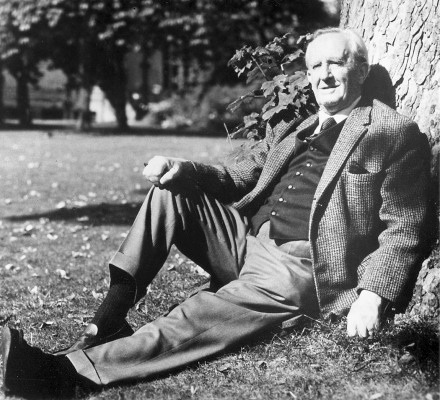
Tolkien Forum and a Few Thoughts

Last Monday the ChildLit GSA held our public discussion forum centered on all things Tolkien. For those of us peripherally interested in, entranced by, and in awe of the monumental library that is J.R.R. Tolkien's comprehensive spectrum of works, this was an ideal opportunity to come clean about our general unawareness of Middle Earth and to openly explore its themes, roots, purposes, and more. Special thanks to Jacqui Yawn, Jill Coste, and Professor Alida Allison for joining us.

The evening started with another rousing Pub(lication) Quiz, highlighting the pop cultural influences of Tolkien's works and general Lord of the Rings and The Hobbit trivia. Basically it served as the perfect primer for discussion before we began our journey into Middle Earth, a balanced dose of fun, challenge, and revelry leading into illuminating discussions. Having spent time researching on various aspects of Tolkien and his works, we were able to put forth a fair number of questions to one another, beginning with topical pop culture issues like the apt or incongruent comparison between Tolkien's works and the Harry Potter Series,the cultural phenomenon that his works have spawned and how that has impacted the fantasy and science fiction genres, and Tolkien's potential opinion of the current films. By the way, if you can make it to Indiana on March 1-3, Valparaiso University is holding a Tolkien Conference.

Conversation moved into more critical issues, including one raised by critic Jared Lobdell questioning whether these works should be categorized as fantasy or not. That led into Tolkien's own perspective of his works, which we gleaned from The Letters of Tolkien, a fascinating and worthwhile read for anyone wanting to see the inner workings of the author and witness his stories unfold and develop. As a philologist, it was no surprise to read how invested and devoted he was to the construction of languages, but we did not anticipate learning that he built the stories literally around the elvish language. In some ways, Tolkien described the point of the books as a "linguistic aesthetic" before moving on to issues of life, death, immortality and the makings of a hero. He argues against critics who claim the apparent lack of religion in the texts, stating that they exist in a "monotheistic world of 'natural theology.'" All in all, I would recommend Letters for insight into his dynamics with his peers, his editors, and his fans; the ramifications of the World Wars on his writing; and classic lines about the nature of graduate student work (would helping us with research really be robbing us of our excuse for existing? He seems to think so).

In a nutshell, the evening sparked debates over many areas of his works and challenged us to consider the purpose of fantasy, of "fairy stories", and the many motivations and inspirations behind writing. We wrapped up with riddles reminiscent of The Hobbit, as well as a few written by Tolkien himself (originally in Old English, no less!). Eventually these will be shared on the ChildLit GSA website, so keep an eye out for that. And finally, for a sweet treat, we shared some sugar cookie "Lembas Bread" to sustain our journeys home. Hopefully all forums will be as fruitful in company, discussion, and baked goods.

The discussion did leave me with some larger questions about language, primarily in fantasy literature. I was particularly awed by the notion of building a story around a language (rather than vice versa as would be expected). I understand that for someone so invested in the lifelong pursuit of understanding languages, this would almost be second nature; nevertheless, the term "linguistic aesthetic" continues to play in my mind. Do The Hobbit and The Lord of the Rings reflect the craft and beauty of Elvish or does language seem supplemental? Can or does all high fantasy require such treatment and focus on words? Is that how we construct myth? I would welcome any thoughts on your views of the linguistic aesthetic.

Finally, a parting thought: Tolkien once wrote on the possibility of an animated film as a welcome idea, finding the risk of vulgarization less painful than the sillification of the BBC. What do you think he means?