Showing posts with label girlhood studies. Show all posts

Friday, April 15, 2022

Notes on Dr. Maria Tatar's Lecture: “A 'Damn Mob' of Scribbling Girls”

    As someone encountering Dr. Maria Tatar’s work for the first time during this event, I was not disappointed! Dr. Tatar is a research professor at Harvard University and specializes in children’s literature, modern German culture, and folklore. Her research includes authors like the Brothers Grimm and Hans Christian Andersen, childhood reading and cultural studies, and folklore and mythology. Her most recent work, The Heroine with 1001 Faces, takes on the staggering yet hidden history of heroines, challenging the male-centric models of heroism in Joseph Campbell’s The Hero with a Thousand Faces. In this latest publication, Dr. Tatar flips the script on what it means to be a “curious” young woman, emphasizing how these girls depart from the canon through their compassion and craft. Her interests culminated in the event titled “A ‘Damn Mob’ of Scribbling Girls: From Jo March to Starr Carter,” which explored girls from popular media and literature who find agency within domestic spaces and enact their power, not only to survive, but to care for others. 

Dr. Tatar began her lecture with images of warrior women – cinematic women who are dramatically armed and ready for battle. She highlights their strength that both ornaments and sustains their femininity. Whether glittering in golden armor or fitted in a flowing red dress while riding in a chariot, these young women embody a feminine power that defies the traditional domestic spaces they find themselves in. In this opening, Dr. Tatar introduces her argument: these girls, trained to accommodate themselves in a society of gendered propriety, rebel against dominant power structures through their craft. 

The first literary work Dr. Tatar introduces is Louisa May Alcott’s beloved novel Little Women. However, she invokes the character Jo March through the film directed by Greta Gerwig (2019) instead of the novel. While Alcott captures all the dimensions of the domestic, the acts meant to make a home comfortable, Gerwig’s Jo March exuberantly displays how reading, writing, and acting are radical acts of rebellion. This emphasis on a young woman’s reach for autonomy allowed Dr. Tatar to identify the potential for heroism within domesticity. She identifies writing as a craft that provides an opportunity for heroism, an action that involves both curiosity and care. Tatar defines craft as cunning design, work that has been carried out in multiple modalities such as knitting, weaving, storytelling, or simply talking. 

In both the novel and the film, the heroes of the story are the fathers heading off to war while the women maintain the home space. Dr. Tatar urges us to ask: Who are our heroes? Our heroines? She grafts onto her argument the concept of the hero from Campbell’s The Hero with a Thousand Faces to assert that women are not the ones receiving the call to action. If anything, this persistence of men at the forefront of heroism has become the Hollywood narrative playbook. It becomes an easy correlation to see men returning from war as a literalized hero’s journey. However, Dr. Tatar reminds us that the return in the hero’s journey is always about healing. Here, in curious and caring spaces, is where women can no longer be silenced. 

The lecture took a poignant turn when Dr. Tatar connected her ideas with the COVID-19 lockdowns we have collectively experienced in the past two years. In lockdown, she notes, we were looking for heroes. We found them in our community caretakers, like doctors and nurses, childcare workers, and educators. More than anything, though, we encountered silence. Like the image of Philomena weaving her tapestry, the concept of heroism faces a cultural reboot during the COVID-19 pandemic. The investment in healing and care work, fields predominantly held by women, found a refreshed prioritization and attention from the public. Dr. Tatar turns to Carlos Fuentes and restates, “Writing is a struggle against silence.” Here, she draws a comparison to the strategy of silenced women. As mentioned before, craft becomes the strategy to find a voice. Through texts and textiles, women speak truth to power. 

One of the tenets of her work, curiosity, is seen as the cardinal sin of women while care is delegitimized on the basis of gender oppressive attitudes. Dr. Tatar moves from writing as a form of discovering identity and self actualization to a desire for immortality. This curiosity thus becomes a commitment to causes these young women are passionate about, concretizing their thoughts and ideas in written word. The literary text Dr. Tatar closes her lecture with is Angie Thomas’s The Hate U Give. Through the protagonist, Starr Carter, Dr. Tatar realizes that self-actualization and a commitment to social causes are not mutually exclusive. From Anne of Green Gables to Matilda, Anne Frank to Harriet the Spy, the craft of writing becomes a mode of achieving an encounter with an empowered self, a political act that speaks truth to power. 

    I was very intrigued by Dr. Tatar’s inspirations for this work. One of the most compelling was Scheherazade, a major female character from One Thousand and One Nights who is also a scholar and reader. She is a storyteller, and known as a master of cliffhangers, who understands the seductive power of stories. Dr. Tatar also emphasizes that she is a survivor, ensuring that others will be saved and protected from the antagonist of her story. She also invokes the classic tales of Pandora and Eve, two young women whose bodies are sexualized and whose curiosity is read as carnal rather than intellectual. Through these figures, she calls on us to consider replacing empathy with curiosity, craft, and care. Rather than universalizing our characters or their experiences, Dr. Tatar invites us to raise critical awareness about the codes of gender that inform power in these texts and, ultimately, the way we perceive “domestic” activities as passive. As she states in the lecture, “readers often seek their mirrors in books.” Through the close reading Tatar promotes, we achieve tools for learning how to navigate our real world relationships via the representations we find in these stories and move with the mob of scribbling women. 

    Readers and writers in the audience also asked some very intriguing questions about Dr. Tatar’s work. Some listeners asked about the labor of our bodies, the work of our hands, and how to reconcile this with the public arena. Dr. Tatar invited us to compare Jo March with Starr Carter, and the modes they used to share their voices. While Jo March hand-wrote her thoughts, Starr Carter takes on a megaphone and a computer keyboard as powerful instruments for securing justice. Other listeners discussed what it means to “give up” one’s femininity in exchange for strength, or if femininity can be perceived as strength itself. Dr. Tatar invokes examples from modern film and media, like Katniss Everdeen of The Hunger Games (dir. Gary Ross) or Snow White from Snow White and the Huntsmen (dir. Rupert Sanders) – both of these young women display strength while also being connected to poetry, song, and art. A few others brought up the question of rethinking passivity from past to present. We’re invited to look more deeply into domestic actions while understanding the circumstances of women like Jo March as narrow. Dr. Tatar inspired me to use that historical past to reimagine curiosity, craft, and care in today’s world. This reimagining allows us to reconstruct our imaging of girlhood while understanding our own writing as heroic.

DN

Friday, November 19, 2021

Introducing: Critical Conversations in Children's Literature - A Web Series

Critical Conversations in Children’s Literature is a web series developed by Dr. Lashon Daley to bring together children’s literature authors and scholars to discuss critical topics brewing within the field. 

The first episode features a conversation between Tae Keller, the 2021 Newbery Award winner, and Dr. Daley, an assistant professor in the Department of English and Comparative Literature, discussing the representations of girlhood presented in Keller's novel, When You Trap A Tiger. Their conversation provides new insights into representations of girlhood as it intersects with concepts of postmodern girlhood, decolonizing girlhood, and the impact of trauma on girlhood. 

Watch it here:


The second episode, part two to Dr. Daley's conversation with middle-grade author Tae Keller, features Dr. Charlene Tung sharing her insights on the historical and theoretical context of When You Trap a Tiger. Tung, a professor of Women's and Gender Studies at Sonoma State University, specializes in gender and globalization, Asian American women's history/contemporary (im)migration, and gender and race-ethnicity in popular culture.

Watch it here:


Critical Conversations in Children’s Literature is funded by the Department of English and Comparative Literature at San Diego State University and is in collaboration with the National Center for the Study of Children's Literature.

We hope you enjoy the series! 

- (NA)

Monday, November 8, 2021

A Discussion of The Witch Boy by Molly Ostertag

Molly Ostertag’s debut middle-grade graphic novel The Witch Boy was first published in 2017. The graphic novel was written and illustrated by Ostertag, and it follows Aster, a boy who wishes to practice witchcraft despite it being forbidden for boys. He lives in a magical community with his family, which is separated from human society and the only contact they have is with other magical families around the area. Each member of the community contributes to sustaining the way of life. The men in the community become shapeshifters whereas the women learn about witchcraft and perform spells. Aster has no interest in shapeshifting or physical fighting, instead, he wants to learn spells and the ways of the witches. Men and boys are forbidden from learning witchcraft since the community adheres to strict gender roles. There is only one man in the community who attempted to learn witchcraft before and it did not go well. Besides the challenges Aster faces due to his gender-nonconforming identity, his cousins are mysteriously going missing.  


While reading this graphic novel, I could not help but pay attention to the representation of girlhood and how the novel constructs it. Currently, I am taking a class with Professor Lashon Daley in which we look at representations of girlhood in Middle-Grade and YA novels. The Witch Boy is a graphic novel that interacts heavily with gender roles and how girlhood has been constructed in a magical society. 


The Witch Boy does not waste any time in depicting girlhood. The graphic novel's construction of girlhood mirrors our society’s image of girlhood. For example, Aster is caught spying on the girls’ magical lesson, and an elder scolds him by saying: “Aster! This lesson isn’t for you -- these girls are learning secrets!” (Ostertag 5). Aster, as a boy, is berated for trying to learn girls’ “secrets.” While reading this, I could not help but think about how girls and boys are separated for sex education in middle school. Boys are not allowed to learn about girls’ bodily changes. The boys in the graphic novel do not have lessons like the girls’; they just play around and sometimes practice their shapeshifting. We learn quickly how gender roles are strictly upheld in this world, which very much mirrors our own. I enjoyed how this is how we are introduced to Aster. Immediately, we know that he does not fully fit into his community because of what is being said to him and where he is on the page (up on a tree at a distance).


In Dr. Daley’s course, we read Megan Henesy’s article ‘Leaving My Girlhood Behind’: Woke Witches and Feminist Liminality in Chilling Adventures of Sabrina,” which centers Sabrina as the gothic figure due to how she navigates two worlds (2). In class, we discussed how Sabrina, as the “woke witch,” embodies the following characteristics: liminality, activism, being 16 years old, being a virgin, encountering a dark wizard, feeling out of place, choosing her place in society, and having a sidekick. I believe that The Witch Boy is a great book to read through this lens. 


Many of the elements of Henesy’s “woke witch” framework are present in The Witch Boy. First we have liminality. Aster exists in two spaces, boyhood and girlhood, and because of this he does not fit into his culture. The second characteristic is “activism,” which Aster engages in due to questioning why boys cannot perform witchcraft. Once Aster is caught spying on the girls’ magic lesson he has a conversation with his mother about not being able to perform witchcraft: “I don’t understand why Juniper and Hazel and them can all learn how to talk to trees and make potions and do spells and I can’t...It’s not fair” (7). After this he goes on to perform magic on his own, challenging the system in place. Furthermore, Aster does not meet the age requirement for the “woke witch.” The Witch Boy is a middle-grade text, and his age is not specified. Aster can be presumed to be an older tween (10-12) or a young teen (13-14). As for the virginal state, The Witch Boy does not engage with sexuality, and due to his age Aster mostly likely fits this criteria of the “woke witch.” Aster does have an encounter with a dark wizard, which in this case is the villain of the narrative. The villain in this text is a dragon-like creature who wants Aster to join him in his dark magic endeavors. The “dark wizard” is similar to Aster, but he has embraced the “dark side” of magic.

The next characteristics of the “woke witch” framework are feeling out of place, choosing your place, and having a sidekick. Aster’s family constantly reminds him that witchcraft is solely for girls. For example, his mom explains to him: “But, Aster, that magic is for you...Women and men have different types of magic” (8). She then tells the story of Mikasi, Aster’s great uncle, who did not adhere to the gender roles and was ostracized in the community, “[h]e was cast out for he was a danger to himself and the family” (11). Aster’s mother lets him know that if he were to practice magic openly he could be banished from the community. This serves as a warning and solidifies how out of place he is within the place he calls home and the people who are supposed to love him unconditionally, his family. Moreover, Aster is able to choose his place when he meets Charlie. She is a human he meets while walking outside his community. They share the same feelings of not belonging in their communities. Charlie is a girl who loves sports and has two dads. As the story progresses she becomes Aster’s sidekick, encouraging him to perform magic. She eventually asks him to heal her injured leg (75-76). 


Aster’s journey in The Witch Boy follows the dynamics of Henesy’s “woke witch,” except for the age. Reading this graphic novel and looking at it through this framework was a fun exercise! I wanted to showcase how children’s literature scholarship can be applied widely and the type of exercises graduate students like me engage in.


I hope you will pick up The Witch Boy by Molly Ostertag because it is truly a wonderful graphic novel. I know I will be reading the following volumes in this trilogy (Hidden Witch and The Midwinter Witch). Also, it is being adapted into a Netflix animated musical, so why not get ahead of the movie release?


References:


Henesy, Megan. “‘Leaving My Girlhood behind’: Woke Witches and Feminist Liminality in Chilling Adventures of Sabrina.” Feminist Media Studies, 2020, pp. 1–15. Crossref, doi:10.1080/14680777.2020.1791929.


Ostertag, Molly. The Witch Boy: A Graphic Novel (The Witch Boy Trilogy #1). Illustrated, e-book, Graphix, 2017.

- (NA)

Friday, October 8, 2021

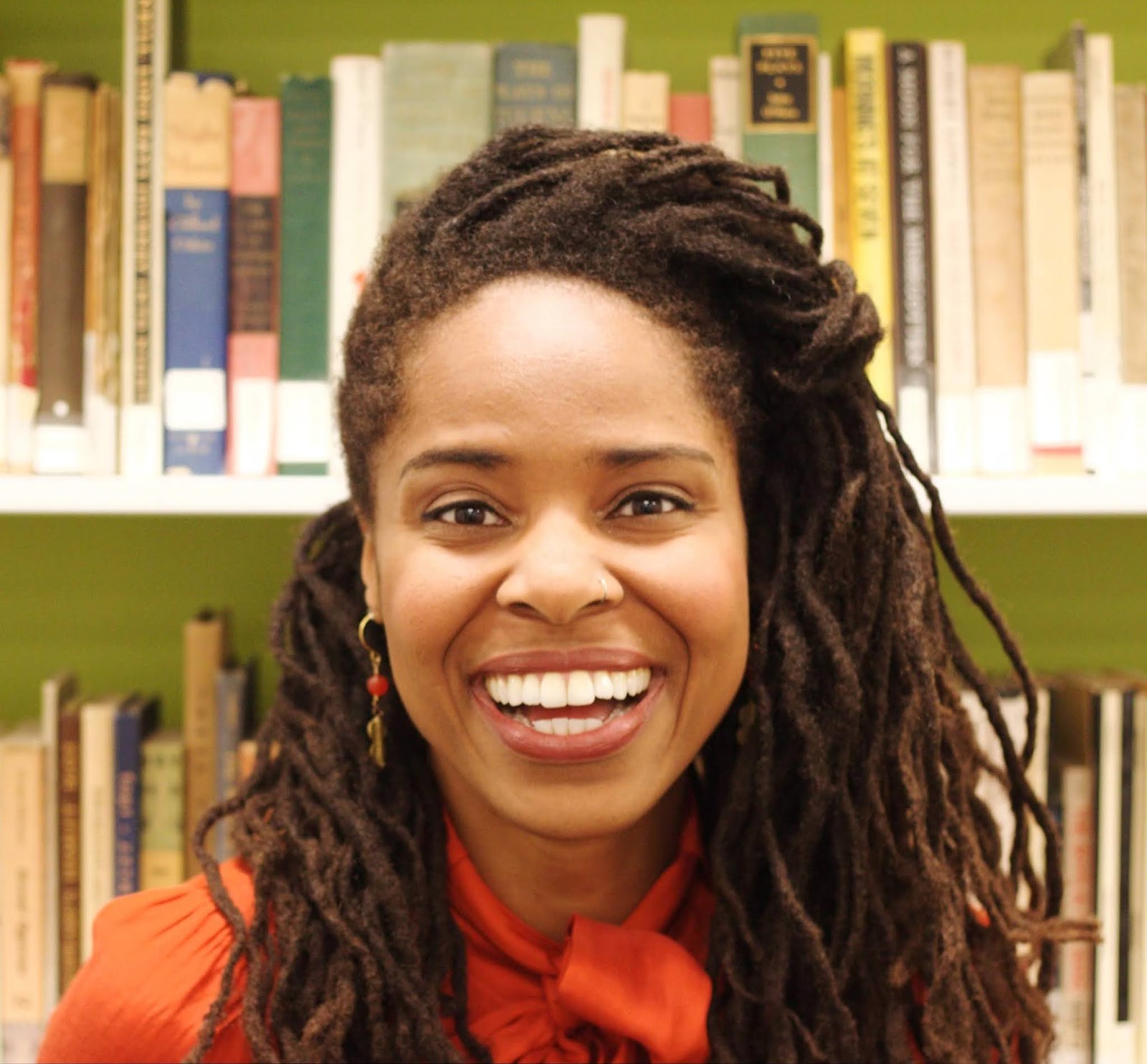
Interview with Professor Lashon Daley

 The NCSCL is honored to present an interview with Dr. Lashon Daley, the Department of English and Comparative Literature’s new assistant professor of children’s literature. The interview was conducted online by Natalie Alvarez and Lara Amin, graduate assistants for SDSU’s National Center for the Study of Children’s Literature. We thank Professor Daley for taking the time out of her busy schedule to talk with us, and we’re proud of the opportunity to better acquaint our readers with our newest professor and her exciting work!


Tell us a bit about yourself: Where are you from? What were some of your favorite books as a child? How did you become interested in children’s literature and childhood studies, and what do you find particularly interesting about it?


I grew up in Miami, Florida, and spent most of my childhood climbing the mango tree in my backyard and the avocado tree in my front yard. As a result, I rarely read for leisure. Being outside and playing with my siblings brought me more joy than reading on my own. And to be honest, I hated reading. I preferred making up stories in my mind and telling them to my very attentive collection of stuffed animals. I did begin writing down my own stories when my mother gave me my first journal at the age of seven. I wrote my first children’s book shortly thereafter. It was about a blue rose that did not know how to bloom and had to learn on its own. 


When I eventually began to tolerate reading, I fell in love with serial collections like The Berenstain Bears by Stan and Jan Berenstain, Clifford the Big Red Dog by Norman Bridwell, and Spot by Eric Hill. In addition, I’ll Fix Anthony by Judith Viorst was also a favorite because it mimicked my experience of being the youngest child and allowed me to feel seen.


As you can see, my love for children’s literature was a slow burn. It finally caught fire when I was working as a marketing assistant at the Louisiana Children’s Museum in New Orleans. I had the privilege of working with my colleagues to implement children’s educational programs, and childhood literacy was a major part of our core mission. I had a running knowledge of what was popular in the industry, what books were used to hit literacy goals, and essentially what made a good children’s picture book. So, I decided to write my own. My children’s book, Mr. Okra Sells Fresh Fruits and Vegetables, was published in 2016 by Pelican Publishing, and it launched me into the industry in a new way. Performing the text at festivals and in classrooms made me even more curious about children’s literature. When the book was released, I was in my first year of my doctoral studies at UC Berkeley. Through a series of research pursuits, children’s literature, especially children’s literature as it intersects with Black girlhood studies, eventually became one of my research fields.


Children’s literature is a fascinating field of study because of its depth and breath. Essentially everyone from children, to parents, to educators, to librarians, to the top 

scholars within the field, to the illustrators, to the writers themselves all, play a role in expanding this field of study. The infinite possibilities of where this field can go means that I am limitless in my research. And for me, that is a beautiful place to be. 


When you applied to SDSU, what aspects of the university and the Department of English and Comparative Literature did you find most attractive?


While my Ph.D. is in Performance Studies, my heart has always been based in English and Comparative Literature. I received my BA in English, my MA in Folklore, and my MFA in Writing. So applying to the department felt like a homecoming for me. I was extremely impressed by my colleagues Phillip Serrato and Joseph Thomas, whose research interests are so fascinating. I felt that I was going to be among scholars who also remained curious and limitless in their approach to the field and to their research. I felt a strong connection to so many of the professors in the department, who are not only top scholars, but also creatives as well. Plus, the opportunity to work with, teach, and mentor English majors and minors is an absolute dream. 


What were the most significant challenges or obstacles for you during or post-graduate school?


When I was pursuing my MFA in Writing at Sarah Lawrence College, I had a desire to pursue publishing after graduation. I did not. However, that desire manifested itself again while I was preparing for my qualifying exams in the third year of my doctoral program. I was feeling so overwhelmed by the requirements of becoming a top scholar that I considered leaving my program. I began to research the job market in publishing and even applied for a position at a children’s literary publisher. I never told my advisor because I knew that she would talk me out of it. Once I passed my exams, I did feel much more confident in my ability to complete my degree. I am grateful that I persevered because now I have the opportunity to continue my research and to be in conversation with those within the industry. 


What seminars would you like to teach? Tell us about them and how they relate to your research. 


I would love to teach a seminar on research methods for fiction writers. Since I pursued my MFA before pursuing my PhD, I feel like I missed out on some crucial knowledge on how to conduct research for my creative master’s thesis. Being taught the craft of writing is super important, but I believe that teaching research methods in MFA programs would be a game changer. I am a really great example of why this is important. For my MFA thesis, I was writing a young adult novel about a Black girl coming to terms with heartache and grief after the tragic passing of her father. Now as a scholar at the intersection of children’s literature and Black girlhood studies, I feel much more equipped to write and construct a world for my character that is based in real-world research.


Which of your current projects excites you the most?


I have some children’s picture book manuscripts that I put on hold in order to complete my dissertation. I am excited about returning to those manuscripts. And then, of course, I am excited about turning my dissertation into a book.


What advice would you give to a student starting graduate school in 2022? 


When you wake up in the middle of the night with the perfect word or sentence for your manuscript, write it down immediately. You will NOT remember it in the morning. 


**


Thank you so much to Dr. Daley! We’re grateful to have the opportunity to showcase SDSU’s brilliant new professor of children’s literature!


- (NA) & (LA)