Showing posts with label Multicultural. Show all posts

Thursday, September 19, 2019

It's Time to "Take the Mic"


Sometimes I feel helpless. Or rather, I can’t help anyone.

I can’t help the people who were told to go back to their country. I couldn’t help the young black man fatally shot for wearing a hoodie. I don’t know how to help children kept in cages. Sometimes I don’t know if it is possible to make a difference just by myself.   

Really, how can we do anything? How can we help those who are wronged by our country?

Take the Mic: Fictional Stories of Everyday Resistance edited by Bethany C. Morrow shows everyone, from children to adults, how to take a stand in the real world and make a difference.


The Helpers by L.D. Lewis is a particularly striking story, surrounding a young girl, Allie, during a sudden city-wide blackout. Unable to find her older sister, a medic named Sasha, Allie leaves her house and goes around the city to find her sister and giving help along the way. She first does seemingly small acts, like providing clean water to help clean a cut, then finds a collapsed building. She begins to help dig people from the building, putting aside her personal goal of finding her sister.

Allie must step into the role of a medic and helps her neighbors hands-on. She runs into a cast of characters, including a white man and a brown man fighting, and the brown man shouting, “I know you did this!” and later says “Nah, his [the white man’s] people came out here and blew all this shit up trying to Make America Great” (44), a reminder that tragedies aren’t just tragedies, they’re political, and they need to be discussed.


This isn’t the only time the current American president is alluded to. In Yamile Saied Méndez’s Aurora Rising, Aurora, an Argentian-American, encounters many instances of racism while staying at her friend Sadie’s house, these instances sounding all too familiar. Sadie’s father comments on Aurora’s cleaning, saying “I guess it’s in the blood, right?” (86). Later, he misidentifies her as Spanish: “Spanish?...But your English’s perfect!” (87).

When things can’t seem to get worse, after ruining her shirt, Aurora is handed a shirt with the words “Clean Up America”, an echo of current misconceptions of immigration. Aurora struggles, thinking: “wearing [the shirt] would be going against my family values…it would be sending a big F-You to my parents’ sacrifices as immigrants in America” (90). She later realizes “any crumb of friendship I’d had with Sadie had died too” (99). In this eerily familiar story, we are reminded of those ridiculed, hurt, and ostracized in our current political climate.

Although we can never go back in time and help those unjustly treated, these two stories served as important reminders: While The Helpers reminds us that we can help others even in small ways, Aurora Rising reminds us of why we need to help others. We not only can be involved in helping a community tragedy, but perhaps as importantly we can try to use our voices for those who may be silenced.

But how can we help right now?

We can educate ourselves on our current political and social climate and learn how we can get involved. Be involved by voting or participating in community marches. Just as important, we can learn to listen to and support others who are faced with injustice. Take the Mic reminds us we need to open both our ears and our hearts to others.

Maybe we can stop another life from being taken of another voice from being silenced, by either taking the mic, or passing it to others who can’t quite reach it.

We can do something. We can make a difference. We are not helpless, as long as we hold out a hand, a heart, a mic to others. 

Take the Mic will be published October 1, 2019.

Thanks to Arthur A. Levine Books for sending this great book to us.

-SS

Tuesday, April 9, 2019

"The Poet X" Is the Next Book You Need to Read


“You need to read The Poet X.”

This is what I texted all my friends as soon as I read the last line of this book; I wanted to tell every person I spoke to that this book would not get out of my head.

Born and raised in New York city and the daughter of Dominican immigrants, Acevedo was a National Poetry Slam Champion and coached for the D.C. Youth Slam Team. The Poet X is her debut novel and quickly became a New York Times Bestseller. It also has won multiple awards including the 2019 Michael L. Printz Award and the 2018 National Book Award for Young People’s Literature. With The Poet X being her debut novel, we are so impressed with her work and cannot wait to see what Acevedo comes out with next. 


The Poet X is a breathtaking novel in verse narrated by the protagonist, Xiomara Batista, who is a passionate and headstrong young Afro-Latina woman growing up in Harlem. Xiomara slowly falls in love with poetry, especially spoken word poetry. Xiomara pours her emotions and reflections of her day to day life into her poetry journal, commenting on topics ranging from pressures from her mother’s religion to gender to sexuality.

Acevedo told Publisher’s Weekly that she “pulls from her experience working with teens and her own high school journals”, which clearly is seen in her poetry, which truly channeling the emotions we can relate to from our teen years. She points to her being first-generation influencing her writing: “There are a lot of the cultural things that inspired aspects of Xiomara, like the ways in which who you are outside of your house is a little bit different than who you must be inside because of the cultural norms that exist. That push and pull that Xiomara carries of being first-generation is something I share.” (Publisher’s Weekly, 2018) Because of her own personal connection, her words evoke so much more meaning and carry weight of being something she has lived through.


Xiomara’s words haunted me at every moment I set down this book. A particularly impactful poem is In Front of My Locker (218). In the poem a boy at school grabs Xiomara inappropriately, and instead of waiting for her friend and crush Aman to say something, she has the realization of not needing to wait for anyone. In the poem In Front of My Locker we see Xiomara standing up for herself:

“For the first time since I can remember I wait.
I can’t fight today. Everything inside me feels beaten…
He’s not going to curse or throw a fit.
He’s not going to do a damn thing.
Because no one will take care of me but me.” (Acevedo, 219)

Xiomara is a girl to look up to, with her strength and dedication driving her actions, even when  everything inside her “feels beaten.” Her emotions are so raw and realistic, and from the first page I found myself cheering for Xiomara and her passion for life.

Acevedo excellently captures the struggles of being a minority teen in her novel, and I can see people everywhere being able to see some of themselves in Xiomara’s story.

“There is power in the word” Xiomara says, and yes, there is power in practically every word of Acevedo’s book. (Acevedo, 353)   

(SS)

Sources:
Acevedo, Elizabeth. The Poet X. HarperTeen, 2018.
https://www.publishersweekly.com/pw/by-topic/childrens/childrens-authors/article/76224-q-a-with-elizabeth-acevedo.html

Wednesday, February 18, 2015

Fighting Anger with Understanding: Some (American) Muslim KidLit Reads

Guest Post from Alya Hameed

If the events last week can remind us of anything, it is that we are beholden to learn and understand, engage and interact with the variety of cultures that define our multitudinous nation. I was plunged into a state of painful fury last week with the hateful murders of three young people in North Carolina—brilliant, unwaveringly kind, and yes, Muslim, students at the University of North Carolina. My first reaction—shock—was immediately replaced with sorrow, anger, and a distasteful lack of astonishment. Sure enough, subsequent news of attacks on mosques, families, an elderly Indian man (who, as a non-Muslim "mistaken" for a "black guy," reinforces the judicial hypocrisy asserted against being black along with the stigma of being brown) and others bolstered that sense of tired expectation, wrought from a growing normalization of Islamophobia in daily discourse.

But I won't live in resignation. Just as Meg recently wrote about one important method of enacting social change (through real successes of children in education), so do I seek out another method.  Thus, I would prefer to dismantle my unsurprised response through literature (in this case, young people's).

That's partly why the massive push for diversity in children's and young adult literature has been particularly poignant for me. While first it spawned out of a desire to find my childhood rationalized in art, now I see my childhood as elusive, not as Susan Honeyman would describe it, but socially out of reach; it simply is not the childhood of Muslim American children now. Instead, my interest has turned toward normalizing—nay, humanizing—a minority defined by current events and increased separation. Breaching a youthful (and older) reader's vision and understanding of the Muslim American experience (or, Western Muslim experience) may give space for compassion and patience by annihilating fear, hate, and the constant reinforcement of otherness in the wake of global events and crises. Empathy is a big deal, folks!

I think the following list of youth literature—from YA novel to picture book, from words to graphics—holds immense potential for propagating societal growth. Especially in this time of social tensions—where misunderstandings can breed hurt and violence—it seems extremely useful to gather a list of stories that speak about and normalize American Muslim kids (or Muslim kids internationally) for the general eye, and bring a lightness and depth that reveals how complex and how relatable these kids are.

Friday, February 21, 2014

New Material Published on the Unjournal of Children's Literature!


It's time to check out The Unjournal of Children's Literature to read its newly published works! This month's works -- articles, interview, and artwork -- continue and complete the first issue's theme of "transformations" and revolve around diversity and Chicano/a identity, focusing on such issues as the need for change in finding and assessing diverse children's lit, the reimagining of motherhood, and understanding the whole child. We are excited to have included an interview with author Pam Munoz Ryan, provocative artwork from two artists, and excellent written pieces from Dr. Phillip Serrato and Megan Parry. 

The compilation of these works further demonstrates the diverse array we want to develop in The Unjournal. Take some time to read these fascinating pieces and reacquaint yourself with the earlier works, and then feel free to leave comments on the journal itself, or via twitter (#childlitunjournal).

Friday, November 8, 2013

A 'Marvel'ous Muslim Teenage Comic Superhero

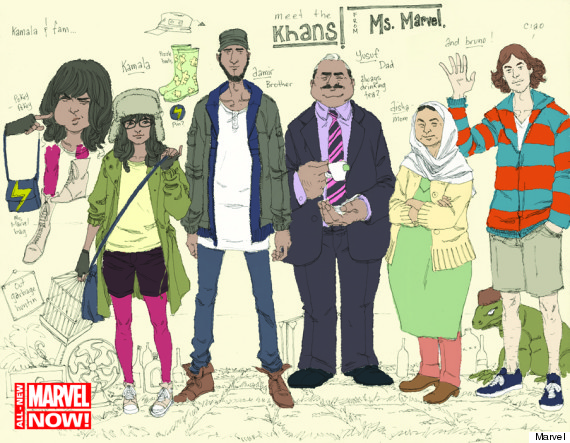
Back in September I talked about the rise of a new cartoon series in Pakistan, the Burka Avenger. It now looks like the female empowerment movement has rubbed off on the world of US Comic-verse. Marvel Comics is introducing a new teenage superhero, who happens to be Muslim-American.

Kamala Khan, aka Ms. Marvel, emerged from amusing life-experience stories of Sana Amanat, an editor at Marvel. She and a peer approached acclaimed graphic-novel and recent novel writer G. Willow Wilson to pen the character. I've never read any of Wilson's works (I'm largely unfamiliar with comics in general, but I have been wanting to get my hands on her debut novel Alif the Unseen). Still, I always perk up at the revelation of a new multicultural text, particular a Muslim-American girl-centered one. While some cultures can attest to an enormous amount of literature including, addressing, or focusing on them (whether or not they get recognized by the mainstream public), the Muslim-American identity still exists on the fringe. It has only been in the last decade or so that children's/YA books have been coming up from Western countries dealing with kids of various Islamic backgrounds. And even of those, not too many from the US as yet.

So this is exciting news! And since she is Pakistani American, I feel a second step closer to the experience meant to be exposed. People who exist in some capacity "on the outside" usually want to find a way to fit in, and to see that unfold via the nature of the superhero should be interesting, and an excellent opportunity to connect with teens searching for an identifiable subject in literature. Still, one hopes it does not stray too far into stereotyped territory. According to the New York Times article linked above:
Kamala will face struggles outside her own head, including conflicts close to home. “Her brother is extremely conservative,” Ms. Amanat said. “Her mom is paranoid that she’s going to touch a boy and get pregnant. Her father wants her to concentrate on her studies and become a doctor.” Next to those challenges, fighting supervillains may be a respite.
But Wilson is quick to point out:
"It was really important for me to portray Kamala as someone who is struggling with her faith.” The series, Ms. Wilson said, would deal with how familial and religious edicts mesh with super-heroics, which can require rules to be broken.
My concern lies in how authentic these struggles remain, if they can consistently ring true as the general isolation felt by teenagers all over, and if at some point the character's story becomes more than just a plot device. In other words, of course this girl's tale will unfold as a battle within her own heart and mind as much as with villains and her parents, but I'm most excited to see when a Muslim-American identity will eventually become a steady presence, such that it doesn't need constant defining and centrality to a text (can it ever be viewed as part of the 'norm'?). But I'm really getting ahead of myself here. For now, I think I'll just live vicariously through this young woman who gets to shape shift and startle evil doers with her amorphous identity.

Thursday, November 7, 2013

CFP: Children's Lit in Multicultural Worlds, "Literature. Children. Time."

5th International Symposium “Literature. Children. Time.”
5th Literary Festival for Children “Dyvokraj”

Children’s Literature in the Multicultural World International Conference
1 - 5 of June, 2014
Submission deadline: April 1, 2014

The conference is held by Petro Mohyla Black Sea State University (Mykolayiv, Ukraine) and Ukrainian Research Centre of Children’s and Youth Literature (Lviv, Ukraine).  The conference is a part of the program of the 5th international symposium “Literature. Children. Time.” Areas of interest for the conference include the following topics:
  • Children’s literature in the context of multiculturalism
  • Postcolonial perspective in Children’s literature Studies
  • Gender Studies and Children’s literature
  • Children’s literature and ideology
  • Canon and identity in literature for children and youth
  • Children’s literature and intermediality
  • Writing for kids in the situation of bilingualism and plurilingualism
  • Graphics and  illustrations: iconosphere of children’s books
  • Ethical dimension of children’s literature
  • Children’s book as a commodity
  • Use of children’s literature for commercial purposes
  • Kitsch and children’s books
  • Children’s Literature in cyberspace

Round-table meeting: reading national propaganda “All of Ukraine reads to kids” – “All of Europe reads to kids”

Working languages of the conference are Ukrainian, Russian, Polish, German and English.

Registration fee for participants is 250 hryvnas (for the former USSR citizens) and 50 Euros (for citizens of other countries), which includes coffee-breaks, lunches, sightseeing tour. The registration fee should be paid when the participants register. Travel expenses and accommodation costs are covered by the participants of the conference.
 
Submission Information
Oral presentations should not exceed 20 minutes. Papers of the conference will be published in two Ukrainian academic journals. The papers of the participants who will not give their oral presentations at the conference will not be accepted for publication.

Abstracts of presentations (up to 200 words) should be submitted by April 1, 2014. The participants of the conference should provide the following information:
  • title of the presentation;
  • last name, first name, middle name, academic degree;
  • name of the institution
  • field of research interests;
  • mailing address, telephone number, e-mail address 
The abstracts and personal information should be sent to Dr. Tetjana Kachak, the Head of Ivano-Frankivsk URCCYL-Branch: e-mail: tatjana-kachak@rambler.ru; telephone numbers: 0038 067 8705724, 0038 099 0475972
 
Manuscript requirements
Prepare your manuscript before submission, using the following guidelines: all files should be submitted as a Word document, Times New Roman, size – 14, interline space – 1.5;  all margins – 2 cm; Microsoft Word count for all text including figures and tables but excluding references should not exceed 20 000 characters with spaces; abstract  is 4000 characters not including keywords; list of cited words is at the end of the paper in the alphabetical order starting with sources written in Cyrillic, then in Latin; references in the text are in square brackets, the first digit indicating number of the source in the bibliography list, the second digit is the number of page, for example, [12, с. 45-46], [9, с. 24].

Deadlines
Abstract submission deadline: April 1, 2014
Notification of acceptance: April 10, 2014

On behalf of the Organizing Committee

Prof. Dr. Oleksandr Pronkevich (oleksandrpronkevych@yahoo.com)
Dr. Ulyana Baran (Hnidets) (urccyl.new@gmail.com)

Thursday, October 24, 2013

Multicultural Perspectives: Syria, Russia and the Potential of Children's Literature

One of the many long term tragedies of wars is the severe cultural loss. Whether by "cultural revolutions" or by the total destruction of a country amid civil war, this loss -- books, art, music, cultural representations and evocations in general -- bears down severe ramifications on its people, including a loss of identity and community and at times a complete misunderstanding or erasure of history itself.  I recently read a post on Mitali Perkins' blog, Mitali's Fire Escape, about her brief knowledge/awareness of contemporary Syrian children's literature (or rather, the struggle to find it). Originally, my intent was to search for children's literature in English with Muslim protagonists (featuring either Muslim American children or set abroad). Instead, I read this post and started to pour over the idea of what cultural loss does to children. I recommend reading through Mitali's post to learn about some literature already in existence and the efforts that emerge within refugee camps to give children a sense of identity once more. Children's books in this sense act purposefully to give children an opportunity to reclaim some notion of community (a valuable gift to refugees).

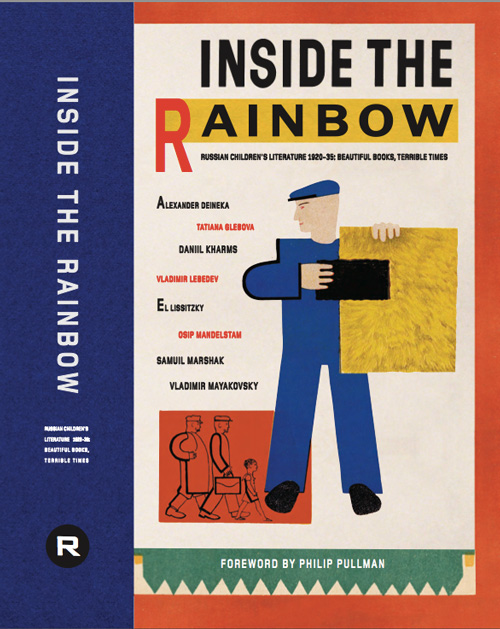
Philip Pullman recently discussed Stalin's purges and the resilient existence and purpose of children's literature during the Great Terror. Specifically, Pullman reviewed Inside the Rainbow: Russian Children's Literature 1920-1935, compiled and designed by Olga Budashevskaya and Julian Rothenstein. This book shares the striking and powerful images and stories of Russian artists and poets who turns to this genre (the child's picture book) to proliferate their political messages. Pullman does a wonderful job of explaining the power and innovation behind the texts and illustrations, but I am most fascinated by the way adults used children's lit in a totalitarian regime; essentially, children's lit became a safe place for subversive thought (and for the adult thinking these thoughts -- far fewer children's lit poets were arrested and killed during Stalin's rule than other authors).  We always talk about the safe spaces and dangerous places that exist within children's stories and what these mean for the child (character and reader). This examination can even extend to the spaces that emerge for "safe reading": cozy corners, treehouses, etc. But here we have the children's book serving as the ideal hiding place for adults. It's not a new concept, I know, but the extent to which this lasted is amazing, and is another reminder of how important and necessary children's lit can be, both for kids and grown ups.

This leads to my last link of the day, a brief essay on the transformative power of children's literature, particularly in committed and political books. In it, the author discusses the many ideological perspectives that the books are soaked in, such as: dismantling myths that adults create to "protect" children (e.g., from the realities of society and the existence of homelessness), instilling a drive and understanding for the need of revolution, or bringing awareness to economic issues, unions, and strikes. "Children's literature is a battleground between conserving the status quo and transforming it; between continuity and change."The child as disenfranchised and disempowered citizen becomes the ultimate tool this time, the overarching purpose behind the text, and the key figure who can act on the messages passed on by the authors and illustrators.

Tuesday, October 15, 2013

CHLA Panel: Authenticity, Artifacts, and Publishing Patterns in MultiCultural Texts

The following CFP sounds incredibly appealing and intriguing to me, falling within my curiosity and exploration for multicultural depictions in children's texts and media. Really looking forward to what this panel becomes. (I have a pile of books dealing with Middle Eastern cultures that I'd want to examine through these questions, but that will have to wait for when I'm not spread so thin among great projects already.)

Call for Papers: Authenticity, Artifacts, and Publishing Patterns in Multicultural Texts

The Diversity Committee of the Children’s Literature Association is seeking papers for its sponsored panel at the ChLA 2014 Conference to be held in Columbia, South Carolina, June 19-21.  (For more information on the conference, visit the ChLA conference website at www.chlaconference.org.)

We are looking for papers that address how “other” cultures are represented in translated, multi-cultural, and cross-cultural texts. Are texts considered “authentic” if they do not conform to common expectations regarding the representation of minority or foreign cultures? Do mainstream perceptions of “authenticity” realistically represent “other” cultural points of view? Does referencing quotidian cultural behaviors, which would not be noted by members of the culture itself, reflect a tendency to treat other cultures as anthropological subjects? Have certain artifacts, narrative structures and themes appeared repeatedly, and through repetition, come to signify authenticity? Have identifiable patterns come to be the publishing and literary equivalents of museum artifacts under glass?

Questions? Contact Claudia Pearson, pearsoncrz@earthlink.net.
Email your 500-word abstract and 2-page CV by 30 November 2013, attaching it in .rtf, .doc, or .docx format, and including your email and phone number.

Tuesday, September 17, 2013

Multicultural Perspectives: Burka Avenger versus Disney

For the latter half of summer, I heard a lot of talk and saw many a screen shot of an emerging star in Pakistan's children's media field: The Burka Avenger. Skipping over the fact that the burka is not a cultural norm in Pakistan (read some insights about that here), this female super hero cartoon topples many of the preconceived notions of heroism and strength by using educational tools--books, pens etc--as her weapon of choice. And the Avenger's day job? A school teacher. One who does not wear a burka, by the way.

What the creators are trying to accomplish is clearly evident: the importance of female education, the power that an individual voice (and superb ninja training abilities) can have, a demonstration of female and child empowerment in general, and a visual challenge to those who would strive for otherwise. Does equating her attire with superhero skills glamorize the potentially limiting uses of the burka? It can, yes, but not necessarily. And what I enjoyed about the cartoon is how the teacher chooses to use it specifically for her own advantage, an important lesson in cultural awareness (that these are choices at all).

The cartoon feeds into the international dialog on Girl's agency too. Last week I shared a link about the merits of paranormal YA, which addressed the explosion of girl-centric YA adventures, dystopias, and science fiction and gave merit to the boom of YA romances. In it, the author did conclude that while a lot of movement has been made, there is still much left to be altered. I couple this with Sophia McDougall's "I Hate Strong Female Characters" to shed light on the fact that young women are prone to be classified as strong but little else. The diversity of their personal character is as sparse as the diversity of their culture. McDougall basically suggests that the sudden explosion of female-protagonist YA has gilded the post-apocalyptic road to serenity with girls whose primary struggle is with troubled romance, apart from having to save the world. Not enough room for character depth.

Of course, there are arguments challenging this. Do I think all female protagonists fall under those clutches? No, and they surely don't need to either. Some would say it isn't a forgone conclusion, and it is important to note that the McDougall focuses on films and television rather than literature. It is quite fair to say, I think, that books allow for more subversive actions, upending of cultural "norms"; they yield a greater amount of charisma for females. Movie adaptations tend to succumb to the aesthetic of visual appeal, and sacrifice story for pretty faces.

Still, even within books, there's a debate about the efficacy of girls' agency. All the more reason that I was impressed with the concepts supporting The Burka Avenger. It is trying quite fervently to place itself as a bearer of empowering thought. It stumbles and suffers from a collection of stereotypes itself, but nothing that impedes the feminine or child's voice. And, as the Huffington Post points out, it teaches Disney six invaluable lessons about heroines.

Wednesday, September 4, 2013

The Multicultural and Murderous in New Children's Lit Scholarship


Here are a few new reads to add to your research and collection. 

The first, Reading Diversity through Canadian Picture Books: Preservice Teachers Explore Issues of Identity, Ideology, and Pedagogy, edited by Ingrid Johnston and Joyce Bainbridge, may appeal to those interested in picture book study, multicultural studies (through a Canadian lens) and pedagogical practices. The description from the UTP site explains:

What is the value of picture books in educating a diverse society? This collection of original essays explores how preservice teachers from faculties of education across Canada engage with issues of diversity and national identity as represented in children’s picture books. Based on research drawn from education courses and student teaching experiences, the book illustrates new and culturally relevant approaches to curricula that meet the needs of increasingly diverse student bodies.

In the second book, Bloody Murder: The Homicide Tradition in Children’s Literature, Michelle Ann Abate discusses the long history of violence that prevails in children's books -- not merely an indicator of American obsession with the grim, but also a sign of the complications, severity, and seriousness that children witness and face in reality. You must read Abate's insightful and excellent interview with the Boston Globe as well. Bloody good stuff.

Wednesday, July 10, 2013

Multicultural Picture Books on Ramadan

Around the world, Muslims have begun to observe fasting during the Islamic month of Ramadan. The next four weeks  will include resisting food and water from dawn until sunset, as well as tempering one's lifestyle to be more reflective, charitable, and understanding.

To celebrate this annual experience, here are two recent picture books that convey the rich messages of Ramadan and contribute to the dearth of diverse literature that exists for children, but need only be sought.

Under the Ramadan Moon, by Sylvia Whitman (2011).
The lyricality of this book makes it stand out, and its repeated verses mirror the importance of ritual and tradition that highlight a single day of Ramadan, including waking up before dawn to eat and pray, and breaking fast among family and friends. It serves as an artful introduction to Ramadan.

White Nights of Ramadan, by Maha Addasi (2008)
I reviewed this book earlier this year for the SDSU Book Reviews. For now I will say that the lush colors bring to life a culturally specific holiday (from Kuwait and other Gulf countries) that occurs midway through Ramadan -- Girgian. It's festive and thoughtful, and does a great job of capturing the spirit of month.


Wednesday, June 12, 2013

CFP: Happiness Conference in Oxford

Call for Papers: Happiness, Childhood, and Children's Literature
16th November 2013, St Hilda’s College, Oxford

"Novels, like paintings or music or sport, should hold out to children the promise of happiness, and the certainty of laughter." -Fred Inglis

Jean-Jacques Rousseau claims that children are born innocent and happy; all their educators need to do is protect this natural state of childhood from being contaminated by society. In the last few years, however, a radical reassessment of happiness has taken place in critical theory, through thinkers such as Sara Ahmed and Lauren Berlant. They point to the social construction of the idea of happiness, how it varies over history and geography, and is based on predominating social values. As such, “happiness” can work as an ideology that welcomes some kinds of lifestyles and excludes others. In particular, they emphasize the difference that gender and sexuality makes to conventional models of a “happy” life. Their resituating of happiness as a normative and often oppressive ideology brings us the opportunity to reassess the place of happiness in children’s literature.

No sustained study of happiness in children’s literature has taken place since Fred Inglis’ The Promise of Happiness: Values and Meaning in Children’s Fiction was published in 1981. Inglis suggests that children’s literature is exempt from the critique of happiness: "Whatever has happened to the idea of beauty and happiness in adult art, our children must keep faith with their radical innocence." However, such children’s books as John Burningham’s Granpa, Neil Gaiman’s The Wolves in the Walls, and Michael Rosen’s Sad Book deal with the loss of loved ones and of home. Such texts reject happy endings, and implicitly or explicitly, see and value more negative emotions such as mourning, fear, and depression in children. These texts raise the issue of the purpose of children’s literature: should it prepare children for sad truths, or shield children from them? In this way, such works move to redefine the "happy ending."

Should children’s literature play a role towards encouraging or defining happiness? How do cultural differences affect children’s happiness? This conference invites papers on happiness in English and French children’s literature or theorisations of childhood.

Topics may include, but are not limited to:
-childhood “innocence”; criminal children; angelic children
-adult nostalgia; childhood idylls
-humour; play; fantasy; utopia
-unconventional modes of happiness; non-normative families; gender and sexuality
-dealing with death, tragedy and war
-representations of depression; angst; suicide
-Rousseau; Winnicott; Klein; childhood and affect
-cultural differences and happiness; post-colonial children’s literature
-adaptation, translation and changing values of happiness

Abstracts of no more than 300 words should be sent to childlithappiness@gmail.com by no later than 21st September 2013.

This one-day conference on Saturday 16th November 2013 at St Hilda’s College, Oxford, is organized by Queen Mary, University of London. We are fortunate to welcome keynotes on French and English children’s literature, highly successful children’s authors, and the renowned producer Martin Pope ) for what promises to be an exciting day.

Keynote Speakers:
Penelope Brown, University of Manchester
Anna Kemp, Queen Mary, University of London (author of Dogs Don’t Do Ballet)
Diane Purkiss, Keble College, University of Oxford (co-author of the Corydon series)
Martin Pope, producer of The Gruffalo and The Gruffalo’s Child films

Wednesday, May 22, 2013

Multicultural Perspectives: ChildLit Festivals in Pakistan

Last September I wrote about the Children's Literature festival in Pakistan--turns out it has blossomed into an insightful and inspiring series of events, inviting resident authors, scholars, and children to two to three day events aimed at broadening awareness for the existence, importance and influence of children's literature in Pakistan. When last I checked, they had held their fourth conference, but it looks like CLF 2013 is ready for its sixth conference this weekend, on May 24-25. It follows on the coattails of the first Literary Festival in Islamabad that was held last month, also successful on its own terms.

I'm really impressed by the tenacity and eagerness of the Idara-e-Taleem-o-Aagahi (ITA), or the 'Center of Education and Consciousness,' who have been organizing these conferences since 2011 with the Oxford University Press. Amid all the mayhem that is painted across media about the state of things in Pakistan, movements like this are vital for the spirit of the local community and serve to develop the regard and support of the international community.

I had the opportunity to interview one of the festival coordinators from ITA, Sheba Sherin, following their November festival. At the time, the festival had incorporated events and activities in honor of Malala Yousafzai, the young Pakistani girl shot last October by the Taliban for her vociferous advocacy of education for girls. She is now one of the most recognizable young faces in the world, being named one of Time's 100 most influential people of 2013 and recently announcing an international grant for girls' education.  The CLF had honored her and Sherin described some of those efforts to me:
Malala was supposed to be the Young Ambassador of the CLF. However during the time we had approached her and were to have her officially on board with us, her unfortunate accident occurred. At the festival we had a special stall known as "Tribute to Malala--Letters, posters and cards dedicated to Malala Yousafzai". At the stall, children were given art materials through which they created beautiful letters and cards for her. Also a special short documentary created by Fauzia Minallah from Funkor Arts, was screened at the inauguration ceremony of the festival. The short animation was a tribute to Malala extending the support of millions for her.
Sherin also shared her insights on the role of children's literature in Pakistani culture. "Enhancing reading abilities and learning through promoting literature and the habit of reading books is something that automatically leads to excellence and brilliance, "she told me, articulating the need to instill in kids the value of books and reading.

At the time that I corresponded with her, the CLF was planning to coordinate events in smaller cities and less urban areas, including Swat and Bahawalpur for holding festivals at a smaller city level. They certainly hit the mark though in holding one in the capital of the country at such short notice. Hopefully this weekend will mark another momentous experience for kids and adults, and continue to spark a zest for learning and literacy, imagination and hope.

Tuesday, March 26, 2013

Grimm, Haiti, and the Art of Influence

I recently read about a new translation of the Grimm's Fairy Tales, selected and translated by Peter Wortsman and worked from the 1857 edition of the German tales. What makes Selected Tales of the Brothers Grimm worthy of acknowledgement--aside from Wortsman's return to "a tincture of concentrated man-eating ogre and ground hag tooth, diluted in blood, sweat and tears, as a potent vaccine against the crippling effects of fear and fury"--is the artwork included, all done by contemporary Haitian artists. This mixing of two cultures may prove to launch a fascinating and unexplored conversation between the text and the world around it, and I am reminded of Jill's previous post about subversion. What does it take to subvert a text (if we even know what subversion means)? In this case, the words hover closely to the original tales (despite the wall that erupts by the very nature of translating) but by coupling them with the artwork of a vastly different culture, does the result offer an altered mode of viewing, understanding, and applying the text? Maybe, maybe not. will the art nurture or twist the text? We'll have to wait until this book is published to see its particular outcome, but the idea lingers.

This consideration also offshoots into the realm of influence. We never tire of the Grimm Brothers' Tales; new translations, imaginings, and adaptations occur left and right and in every medium (movies, television, art, etc.); their presence in Western Culture cannot be ignored. I'm not very familiar, however, with the nature of their infuence in other regions: Asian, African, South American... So to combine the Grimm tales with Haitian artistry not only makes me curious about new readings, but also about the broader issue of who will bear a greater influence on the interpretation of the other?

A few weeks ago I was caught by the headline of the following article: The Most Influential Publisher You've Never Heard of. Influential? So curious to see who! and how! One click revealed a spotlight on Room to Read, an NGO I have followed for some time and have much respect for. I admit I was slightly concerned about what kind of influence they were imparting, but the article describes their work in creating native language children's books. Rather than translating English stories into other languages, they enlist the work and cooperation of local people to write and publish their own stories. "If the books were to work — to make kids read and want to keep on reading — they had to be culturally relevant."  So in what capacity is Room to Read influential then? Certainly not in terms of Western culture through text (like a translation of the Grimms Tales in Nepal might be received... or not) but within the terrain of literacy and education, yes. And in trying to instill a love of (local) language, probably. Influence as a tool ends up taking many different shapes; are some more acceptable, more appetizing, more ethical than others? How do we know?

Wednesday, February 6, 2013

CFP: Cultural Minorities in Children's Literature and Verbal Culture Conference in Iceland

This is an invitation to participate in the campUSCulturae network and a third Call for Papers for the conference:

Cultural Minorities in Children's Literature and Verbal Culture

April 24th and 25th 2013, in Reykjavík, Iceland

Arranged by The Vigdís Finnbogadóttir Institute of Foreign Languages, University of Iceland in cooperation with:

- The campUSCulturae Network
- The Nordic Culture Fund
- The Committee for Nordic Studies Abroad

We invite the submission of papers in the field of cultural minorities in children's literature and other verbal culture, as well as related fields.

The conference will have two central themes which may be divided into separate seminars:
• Minority Children’s Literature versus Global Popular Culture
• Children's Culture and Roots of Minorities


Keynote speakers:

Minority Children’s Literature versus Global Popular Culture
• John Stephens, Emeritus Professor at Macquarie University, Australia
• Karin Langgård, Associate Professor at the University of Greenland, Nuuk
• Turíð Sigurðardóttir, Professor at The University of the Faroe Islands, Thorshavn
• Vuokko Hirvonen, Professor at The Sámi University College, Guovdageaidnu, Norway

Children's Culture and Roots of Minorities
• Helene Ehriander, Assistant Professor at Linné University, Sweden
• Iram Haq, Author and Illustrator, Oslo, Norway
• Maria Österlund, Assistant Professor at the Aabo Academy, Sweden
• Nina Christensen, Head of Centre for Children´s Literature, Aarhus University, Denmark

Speakers from the campUSCulturae network
• Xosé A. Neira Cruz, Professor at the University of Santiago de Compostela, Spain
• Sofiya Zahova, Specialist at The Bulgarian Academy of Sciences


Guidelines for submission of abstracts:

Proposal abstracts (250-500 words) should be sent to the The Vigdís Finnbogadóttir Institute of Foreign Languages by February 20th, 2013, to infovigdis@hi.is. Please use the subject header: campUSCulturae_your last name_first name initials. In the e-mail message, please include the following:
• Title
• Theme under which the paper should be placed
• Abstract of presentation
• Name(s) and affiliation(s) of presenter(s)
• Contact address: e-mail and phone number

The conference fee is 200€ which includes food and light refreshments during the conference, payable online on http://conference.hi.is/campusculturae/registration/

Keynote lectures will be given in English but workshops will be organized in the Nordic languages. A possibility remains to give lectures in other languages upon request.

Publications

Papers presented at the conference may be submitted for publication. Guidelines for submission will be featured if applicable on the conference website.

Further information: www.conference.hi.is/campusculturae

The Vigdís Finnbogadóttir Institute of Foreign Languages is a research institute within the University of Iceland. It is comprised of faculty members who teach modern languages and cultures, the classical languages, and translation studies. The Institute has the honour of bearing the name of Madame Vigdís Finnbogadóttir, the former president of Iceland (1980-1996). She was the first woman in the world to be democratically elected as a head of state and now serves as UNESCO’s first, and so far only, Goodwill Ambassador for Languages.

Tuesday, January 22, 2013

Multicultural Perspectives: Ilyas and Duck Search for Allah

I stumbled upon Ilyas and Duck Search for Allah, by Omar Khawaja, entirely at random (oh the glories of the internet and its mysterious ways). Immediately I was taken in by two things: the title and the duck. I haven't seen many American Muslim picture books, least of all an open and unobtrusively thoughtful one with "Allah" in the title (which means "God" in Arabic, for the unawares), so I wanted to see how this presented itself. And upon reading it, I admit I immediately loved the little sidekick Duck. Ilyas of course is an adorable inquisitive little boy with such profound thoughts but the absurd antics caught in the illustrations of Duck must surely tickle many a funny bone. So overall, the book was a win for me—accessible characters breaching a complex issue with the honesty and curiosity only a child can demonstrate with a touch of humor. Khawaja introduces readers to an Islamic perspective that demonstrates the universality of beliefs in a colorful and educational adventure.

I had the chance to ask Khawaja a few questions about his book, its purpose, and so forth, and am happy to share that exchange here.

Share a little bit about your book. What are the key themes and issues?

Ilyas & Duck Search for Allah
is about a boy's quest to find God. Ilyas is a typical 5 year old boy with an insatiable appetite for questioning the world around him. Duck is fun-loving, goofy and quick to help Ilyas satisfy his many curiosities. Because kids often think in literal terms, the story too begins with Ilyas thinking that he is able to find God in His physical form. This leads the two characters on an exciting adventure to various parts of the world to find Him. Along the way they meet interesting characters who ultimately help Ilyas and Duck understand the concept of God. The clear challenge in the story was to transform kids' literal interpretation of God into a more abstract and philosophical view that is both simple enough for kids to comprehend and consistent with the Islamic faith. 

What was the inspiration and/or motivation behind it?

Young kids ask the most simple yet profound questions about the world around them. Asking about God then is a natural part of this innocent wonder especially if God is referenced in the home over the course of a typical day. My three young kids are no different and ask more questions than I am equipped to effectively answer. So when my kids presented me with the question about God, I initially struggled to deliver an adequate response.  But as I thought about it I realized that a response to a profound question like this could only be meaningful to young minds if it was delivered in a way that they can relate to. I couldn't think of a better way to do that than through a storybook. So I can safely say that my own kids inspired me to write the book.

As part of my Multicultural Perspectives series, do you feel that Ilyas and Duck addresses or attempts to transcend cultural boundaries? In what ways?

In writing the story my goal was simply to help young kids understand the somewhat abstract concept of God.  And being a Muslim parent, I used "Allah" to refer to God because I was mainly directing the story to other Muslim parents. By using "Allah" in the story however, my intention was not to distance the Islamic view of God from that of other faiths. Rather I believe that given the universally applicable idea around the existence of our "creator" across all monotheistic religions, Ilyas and Duck do cross cultural boundaries by showing that we all believe in the same God regardless of how we refer to Him.  In that sense, my hope is that people will realize that if they simply replace "Allah" with "God" or "Hashem" for that matter, that the message in the story about the existence of God remains consistent with their own belief.

What audience do you hope to reach? Why is a book like this important for the greater American and worldwide audience? What does it contribute?

I think there is such a huge gap in the market for quality books for young kids that communicate Islamic themes and values that I hope Ilyas and Duck will help fill this void and be appreciated by the tremendous global Muslim population. Beyond books though, I believe Ilyas and Duck has the [global] potential... This is especially true considering the vast majority of cartoons that dominate television networks in the Middle East and other Muslim countries today originate mainly from the US, Europe and Japan. There is nothing wrong with that but I think there is room and demand nonetheless for characters that appeal more directly to the local cultures in these markets.
I have had conversations with people that clearly have very little understanding about the Islamic faith. Some believe that Muslims pray to a different God than do Christians and Jews. So to the extent that the use of "Allah" in the story sparks conversations that help dispel some of these misconceptions I think contributes in a positive way to a wider American and global audience.

Did you do any kind of research for the development of the story? 


I had to make sure that the core message in the story was appropriate and widely acceptable to my target audience. I started with my own simple understanding of what I thought Islam said about God. I summarized this in a rhyme within the story the ends with "But you can't see Allah like you can see me." The idea was to position the story through the understanding that you can't see God like you can see others but rather we see God through his amazing creations, and through them we believe Him to be true...  However, it wasn't enough to just have a good message if the delivery of that message was weak. This is where the many nights I spent reading wonderful storybooks to my kids played a role. Over time I had come to appreciate the finer points that made children's books effective for both children and parents and tried to apply this understanding when developing and writing this story.

Will Ilyas and Duck have other adventures?


I currently have two more stories in the works in the Ilyas and Duck series. I also am translating the current book into an interactive storybook app that I'm really excited about which should be available sometime in 2013.